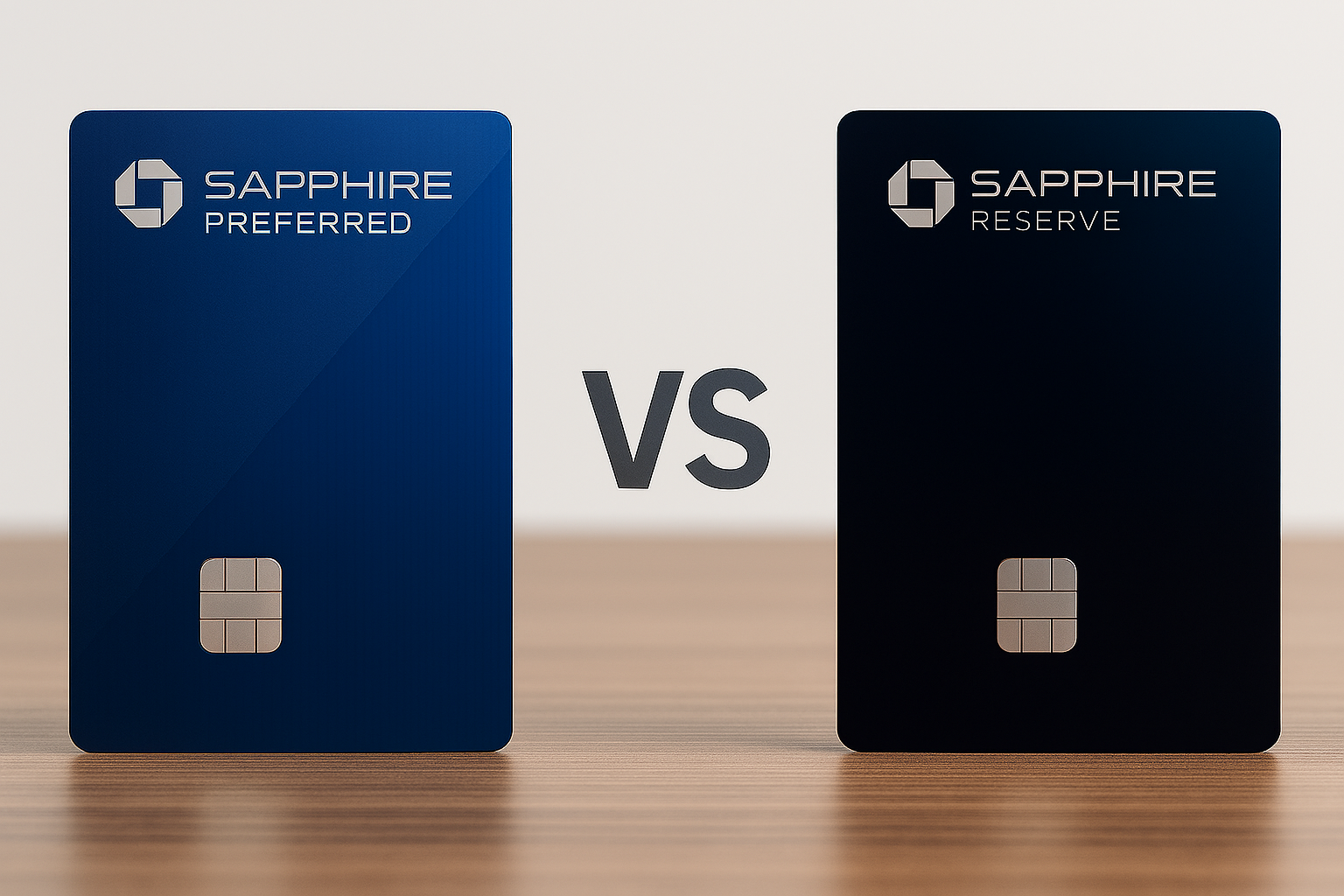
The Chase Sapphire Preferred and Chase Sapphire Reserve are two of the most talked-about travel credit cards on the market — and for good reason. Both earn Chase Ultimate Rewards points, both offer strong travel protections, and both punch well above their weight for frequent travelers. The question isn't whether either card is good. The question is which one is right for you.
We've held both. Right now we carry the Reserve, and after years of using each card in the real world — at airport lounges, on hotel bookings, through Lyft rides and OpenTable reservations — we have a clear view of where each card earns its keep and where it falls short.
This isn't a breakdown built from press releases. It's an honest comparison for travelers who are serious about their points strategy and aren't intimidated by a premium annual fee — as long as that fee actually pays for itself.
Chase's 5/24 rule applies to both cards — if you've opened 5 or more credit cards across any bank in the last 24 months, Chase will likely deny your application regardless of your credit score. You also cannot hold both Sapphire cards simultaneously, and you're generally ineligible for a welcome bonus if you've received one on either Sapphire card in the past 48 months.
The Core Difference Between These Two Cards
At the highest level, the Preferred and Reserve are built for different types of travelers.
The Chase Sapphire Preferred ($95/year) is designed for the traveler who wants a strong rewards card without paying a premium annual fee. It earns well on travel and dining, offers solid travel protections, and provides access to Chase's transfer partners — the real engine of the Ultimate Rewards program. For someone who travels a few times a year and wants a capable everyday card, it's hard to beat at the price.
The Chase Sapphire Reserve ($795/year) is built for the traveler who spends meaningfully on travel and dining and wants a card that actively reduces the cost of every trip. The higher fee is real, but so are the credits and benefits that offset it — and for the right person, the Reserve doesn't just pay for itself. It comes out well ahead.
"The $795 annual fee on the Reserve sounds alarming until you actually map out the credits. For frequent travelers, the card pays for itself before you've taken a single flight."
Both cards earn Chase Ultimate Rewards points, which are among the most valuable and flexible points currencies available. You can redeem them through the Chase travel portal, transfer them to airline and hotel partners, or use them for cash back. The difference is in how much those points are worth at redemption time — and that's where the Reserve pulls ahead.
Annual Fees — What You're Actually Paying
Let's be direct about the numbers:
| Chase Sapphire Preferred | Chase Sapphire Reserve | |
|---|---|---|
| Annual Fee | $95 | $795 |
| Authorized User Fee | $0 | $195 per user |
| Point Value (Portal) | 1.25 cents each | 1.5 cents each |
The $700 gap between the two cards is significant on paper. But the Reserve offsets its fee with a stack of credits that, if you use them, bring the effective cost well below $795 — and for active users, well below zero. More on that in detail below.
The point value difference matters more than most people realize. When you redeem through Chase's travel portal, Preferred points are worth 1.25 cents each while Reserve points are worth 1.5 cents each. On a 125,000-point redemption, that's a $312 difference — just from the redemption multiplier alone.
Welcome Bonuses
Both cards periodically offer elevated welcome bonuses. Current offers can vary, so always verify at chase.com before applying — but typical structures look like this:
Chase Sapphire Preferred: A strong welcome bonus after meeting a minimum spend threshold in the first 3 months. Check the current offer at chase.com for the latest point total and spend requirement.
Chase Sapphire Reserve: Currently offering 125,000 points (with a limited-time offer of 150,000 points) after spending $6,000 in the first 3 months — worth $1,875 through Chase Travel at the 1.5 cent redemption rate, or potentially more through transfer partners.
The Reserve's higher portal redemption value means the same number of bonus points is worth more in your hands. If you're planning to transfer points to airline or hotel partners rather than book through the portal, this is no longer a wash between the two cards. As of June 2026, Chase is cutting the Ultimate Rewards-to-Hyatt transfer ratio from 1:1 to 4:3 for the Preferred — the Reserve keeps 1:1. For airline transfer partners, both cards still transfer at the same ratios, so bonus value is equivalent there. But if World of Hyatt is part of your strategy, the Reserve's transfer ratio is now a meaningful part of the math, not just a footnote. See our full breakdown of the 2026 Hyatt transfer change for the timeline and what it means for existing Preferred holders.
If you're on the fence between cards and can only get one welcome bonus (remember the 48-month rule), start with the Reserve if you'll use the credits consistently. The higher portal redemption value means your welcome bonus goes further, and you lock in the better card from day one. If you're not ready for the $795 fee, the Preferred is an excellent starting point — you can product-change to the Reserve later without triggering a new application.
Earning Points — Where Each Card Wins
Both cards earn Ultimate Rewards points, but the earning rates differ:
| Category | Preferred | Reserve |
|---|---|---|
| Chase Travel Portal | 5x | 8x |
| Flights & Hotels (booked direct) | 2x | 4x |
| Dining | 3x | 3x |
| Other Travel | 2x | 3x |
| Lyft | 5x | 5x |
| Streaming Services | 3x | 1x |
| Online Grocery | 3x | 1x |
| Everything Else | 1x | 1x |
A few things stand out here. The Reserve earns 4x on flights and hotels booked direct versus the Preferred's 2x — a meaningful difference if you spend heavily on those categories. Book through Chase Travel and that jumps to 8x on the Reserve versus 5x on the Preferred.
Both cards now earn identical 5x on Lyft rides, so that's no longer a differentiator. The Preferred retains an edge on streaming and online grocery, which matters if those are significant spending categories for you. For a traveler whose biggest monthly expenses are flights, hotels, and restaurants, the Reserve wins the earning battle cleanly.
It's also worth noting: if you have a Chase Freedom Unlimited or Chase Freedom Flex in your wallet alongside either Sapphire card, you can pool all your points together and unlock the higher redemption rates. This "Chase trifecta" approach is how serious points collectors maximize every dollar.
Travel Benefits Side by Side
Both cards come with solid travel protections that most people don't fully appreciate until they need them:
| Benefit | Preferred | Reserve |
|---|---|---|
| Trip Cancellation/Interruption | Up to $10,000/person | Up to $10,000/person |
| Trip Delay Reimbursement | After 12 hours | After 6 hours |
| Baggage Delay | After 6 hours | After 6 hours |
| Auto Rental Coverage | Primary | Primary |
| Travel Emergency Assistance | ✓ | ✓ |
| Global Entry/TSA PreCheck Credit | ✗ | $120 every 4 years |
| Priority Pass Lounge Access | ✗ | ✓ |
| Chase Sapphire Lounge Access | ✗ | ✓ |
The trip delay reimbursement difference is underrated. Six hours vs. twelve hours is the difference between a covered overnight hotel stay and being stuck paying out of pocket on a long delay. If you travel frequently enough, this benefit alone will pay for itself eventually.
Primary auto rental coverage on both cards is significant — it means you can decline the rental company's collision damage waiver entirely, saving $15–30 per day on every rental.
Lounge Access — The Reserve's Biggest Edge
This is where the Reserve separates itself most dramatically from the Preferred — and from most other premium travel cards.
The Reserve comes with Priority Pass Select membership, which grants access to over 1,300 airport lounges worldwide, with up to two complimentary guests. Priority Pass lounges vary in quality, but even an average lounge — free food, quiet seating, reliable Wi-Fi, a drink or two — is worth $30–50 per visit versus buying food and drinks at the terminal. For a frequent traveler, this benefit alone can justify a significant portion of the annual fee.
But the bigger deal for us personally is the Chase Sapphire Lounge network. Chase has been expanding its own branded lounge network at major U.S. airports, and the quality is genuinely excellent — well above the average Priority Pass property. The lounges feature curated food and beverage programs, comfortable seating, and a premium experience that rivals Amex Centurion Lounges at a fraction of the card cost. Reserve cardholders get complimentary access; Preferred cardholders do not.
Chase Sapphire Lounges are currently operating at Boston Logan (BOS), Hong Kong (HKG), Las Vegas (LAS), New York LaGuardia (LGA), New York JFK (JFK), Philadelphia (PHL), Phoenix (PHX), San Diego (SAN), and Washington Dulles (IAD), with additional locations in expansion. The network is growing — this is a benefit that's getting more valuable over time, not less.
If you fly through airports with Chase Sapphire Lounges regularly, this benefit shifts the math considerably. Two or three lounge visits per month at a conservative $40 value each adds up to $960–$1,440 in annual value — well above the card's fee on its own.
The Credits That Make the Reserve's Fee Disappear
The Reserve's $795 annual fee looks very different once you map out the credits that offset it. Here's an honest accounting of what's available and how we actually use them:
$300 Annual Travel Credit The most straightforward credit on the card. The first $300 you spend on travel each year is automatically reimbursed — and Chase defines travel broadly. Flights, hotels, Airbnb, Uber, parking, tolls, and more all qualify. For anyone who travels at all, this credit is essentially automatic. It brings the effective annual fee from $795 to $495 before you've touched anything else.
$300 Annual Dining Credit (OpenTable Exclusive Tables) Up to $150 in statement credits from January through June, and another $150 from July through December, for a total of $300 annually. The credit applies when dining at restaurants part of the Sapphire Exclusive Tables program on OpenTable — a curated list of participating restaurants, not every OpenTable listing. Check opentable.com/sapphire-reserve-exclusive-tables for the current roster. If any are regulars for you, this credit is easy to capture twice a year.
$300 in DoorDash Promos + DashPass A complimentary DashPass membership (a $120 value) plus up to $25/month in DoorDash promos — a $5 credit on restaurant orders and two $10 credits on grocery and retail orders each month, through 12/31/27. Activate DashPass through the DoorDash app with your Reserve as the payment method.
$300 Annual StubHub Credit Up to $150 in statement credits from January through June and another $150 from July through December — $300 annually — on StubHub and viagogo purchases through 12/31/27. One-time activation required through chase.com or the Chase app. Sports events, concerts, theater — if you buy tickets at all, this credit captures itself.
$120 Annual Lyft Credit $10/month in Lyft in-app credits through 9/30/27. Add your Reserve to the Lyft app to activate. Combined with 5x earning on Lyft rides, this card remains strong for ground transportation.
$288 Apple TV + Apple Music Complimentary Apple TV and Apple Music subscriptions through 6/22/27 — a combined value of $288 annually. One-time activation required through chase.com or the Chase app. If you already pay for either subscription, Chase's complimentary version automatically suspends your paid one.
$120 Annual Peloton Credit $10/month in statement credits on eligible Peloton memberships through 12/31/27. Activation required at onepeloton.com/digital/promotions/chase. Applies to All-Access, App+, Guide, and Strength+ memberships.
$250 Credit for Select Chase Travel Hotels Through 12/31/26, up to $250 in statement credits on prepaid hotel bookings through Chase Travel at IHG Hotels & Resorts, Montage, Pendry, Omni, Virgin Hotels, Minor Hotels, and Pan Pacific Hotels. Two-night minimum required.
$500 Credit for Stays with The Edit The Edit is Chase's curated collection of premium hotels. Book a prepaid stay of two nights or more and receive up to $250 per booking in statement credits, up to $500 annually. Combined with complimentary property credits, daily breakfast for two, and room upgrades where available, The Edit is one of the most underrated benefits on the card.
$120 Global Entry / TSA PreCheck Credit Up to $120 every four years as reimbursement for the application fee. At this point Global Entry should be on every frequent traveler's card — it pays for itself the first time you skip a two-hour customs line.
When you add it all up honestly, the Reserve's effective annual cost for an active user is not $795. It's significantly below zero.
The $75K Spending Tier — Hidden Perks Most People Miss
Most Reserve cardholders never hear about this — but if you spend $75,000 or more on the card in a calendar year, a second tier of benefits unlocks that meaningfully raises the card's value ceiling.
World of Hyatt Explorist Status Hitting $75K in annual spend (effective April 1, 2026) triggers automatic World of Hyatt Explorist status — Hyatt's mid-tier, sitting between Discoverist and Globalist — for the remainder of the calendar year and the following year. Explorist normally requires 30 qualifying nights, and includes 20% bonus points on stays, an upgrade to the best available room (excluding suites), 2pm late checkout when available, premium Wi-Fi, and daily bottled water. It's a genuinely useful mid-tier status to unlock through spend rather than nights — though it's worth being clear-eyed that Explorist is the middle tier, not Hyatt's top one. Globalist (Hyatt's highest tier, with suite upgrades and lounge access) still requires 60 nights or equivalent spend, and isn't part of this benefit.
IHG One Rewards Diamond Elite Status The $75K tier also upgrades your complimentary IHG status from Platinum Elite (included with the base card) to Diamond Elite — IHG's top status tier — for the remainder of the year and the following year.
$250 Credit for The Shops at Chase Additional statement credits toward purchases at The Shops at Chase activate at the $75K tier, stacking on top of your existing credit load.
$500 Southwest Airlines Chase Travel Credit + A-List Status Hit $75K and Chase adds $500 in Southwest Airlines credits for flights booked through Chase Travel, plus Southwest Rapid Rewards A-List status — without flying a single qualifying segment.
For most cardholders, $75,000 in annual spend on a single card is a stretch. But if you run business expenses through the card, pay quarterly taxes, or consolidate household spending aggressively, it's more achievable than it sounds. And if you're close — say, $60–65K in a year — it's worth evaluating whether pushing the remainder onto the Reserve to unlock these status benefits makes sense versus spreading spend across other cards for category bonuses.
The $75K tier isn't something most cardholders will hit, and the Reserve is already an exceptional card well below that threshold. But it's worth knowing it exists — particularly if you're a Hyatt loyalist who has ever wished your credit card spend counted toward your status clock.
For a full breakdown of how to maximize Hyatt points and status benefits, our World of Hyatt guide covers everything from earning rates to the best redemption sweet spots.
Which Card Is Right for You
Choose the Chase Sapphire Preferred if:
- You travel a few times per year but don't want to think hard about maximizing credits
- You spend significantly on streaming, online groceries, or dining and want strong multipliers without a high fee
- You're newer to travel cards and want to build a points foundation before committing to a premium card
- You want solid travel protections and transfer partner access at a fraction of the Reserve's cost
Choose the Chase Sapphire Reserve if:
- You travel frequently enough to use lounge access more than 4–5 times per year
- You regularly use DoorDash, StubHub, or Lyft — the credits are genuinely easy to capture
- You dine at restaurants on the Sapphire Exclusive Tables roster and can use the semi-annual OpenTable credit
- Your travel and dining spend is high enough that the 4x and 8x earning rates meaningfully outpace the Preferred
- You want the best-in-class travel protections, particularly the 6-hour trip delay reimbursement
- You fly through airports with Chase Sapphire Lounges regularly
- You value World of Hyatt as a transfer partner — as of 2026, only the Reserve retains the 1:1 transfer ratio to Hyatt; the Preferred moves to 4:3
The honest truth: if you have to ask whether you'll use the Reserve's credits, the Preferred is probably the right card. The Reserve rewards people who are already living a life that intersects with its benefits — frequent flyers, regular diners, Lyft riders, live event attendees. If that's you, the Reserve isn't just worth it. It's one of the best value propositions in premium travel cards.
"The Reserve isn't for everyone — but for the traveler who actually uses its benefits, it's not a $795 card. It's closer to a card that pays you to hold it."
The Final Edit
Both cards are excellent. The Preferred is one of the best mid-tier travel cards on the market at $95 — strong earning rates, real transfer partner access, and solid protections. For a first or second travel card, it's hard to argue against it.
The Reserve is for the traveler who's ready to commit to a premium card and will actually use what they're paying for. Lounge access, Lyft credits, DoorDash promos, StubHub credits, The Edit hotel stays, Apple TV and Apple Music, dining credits at Exclusive Tables restaurants — these aren't aspirational benefits. They're things active users capture consistently, and they reliably reduce the effective fee to well below zero.
If you're already deep in the Chase ecosystem — holding a Freedom Unlimited or Freedom Flex alongside your Sapphire — the Reserve's 1.5 cent redemption rate supercharges your entire points stack. Every point earned across every Chase card is worth more the moment you have a Reserve in your wallet.
For a deeper look at how to actually deploy Chase Ultimate Rewards points for maximum value, our Chase Ultimate Rewards guide walks through the best transfer partners, sweet spots, and booking strategies. And if you're using your points for hotel stays, our World of Hyatt guide covers one of the best Chase transfer partner programs available — including how we used points for a nearly free stay at the Andaz Maui at Wailea.
Card benefits, fees, and offers are subject to change — always verify current terms at chase.com before applying. The Global Edit may earn a commission if you apply for a card through links on this site. This does not influence our recommendations or editorial verdict.
Editorial Disclosure: This article was written with the assistance of artificial intelligence and reflects the author's honest research, experience, and editorial judgment. AI-assisted content on The Global Edit is always reviewed, edited, and approved by our editorial team before publication.