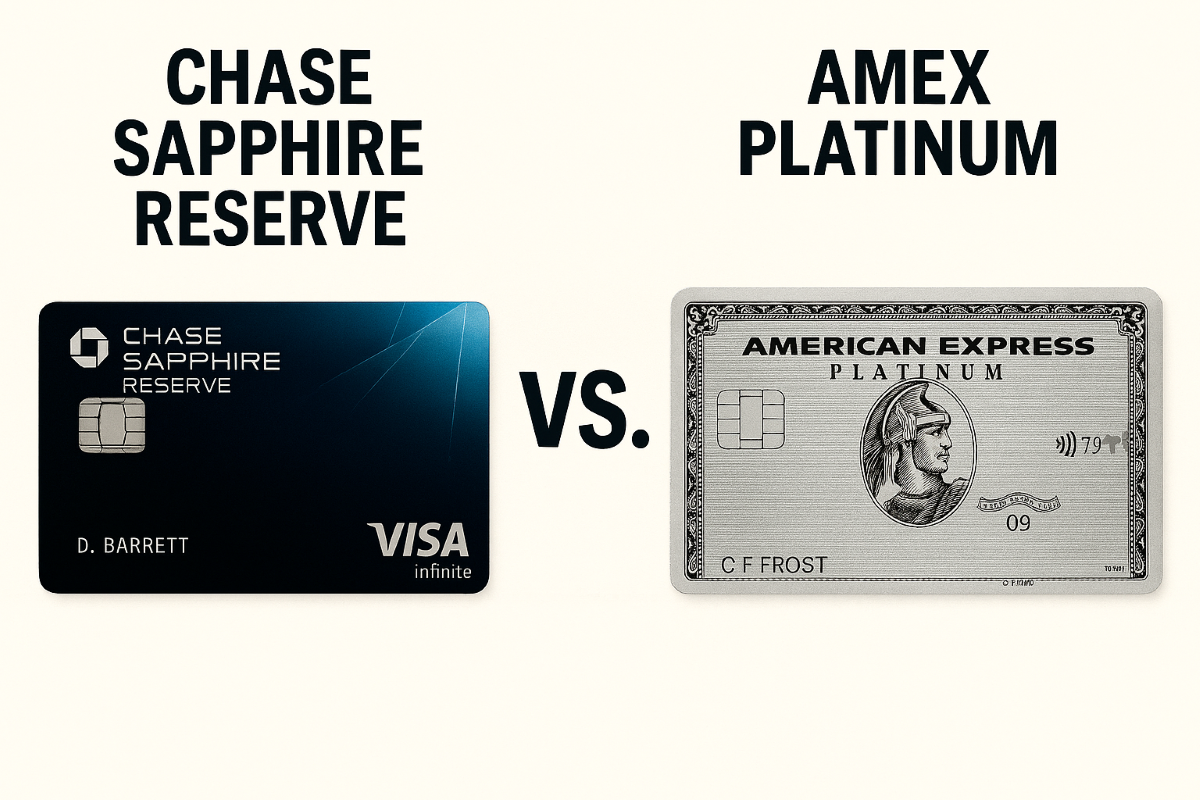
Most credit card comparisons spend their time on bullet points and benefits tables. This one won't. Because the honest answer to "Amex Platinum vs Chase Sapphire Reserve" isn't a spreadsheet — it's a question about how you actually live and travel.
We've carried both. Right now we run the Chase Sapphire Reserve as our primary card and have held the Amex Platinum long enough to know exactly where each one earns its keep and where it falls flat. The $895 Platinum fee and the $795 Reserve fee are both real numbers that demand honest accounting — and the answer to which card wins depends entirely on what kind of traveler is carrying it.
Here's the full breakdown.
Two Cards, Two Philosophies
Before comparing line items, it helps to understand what each card was designed to do.
The Amex Platinum is a premium travel card built around access and lifestyle credits. Its core value proposition is experiential: Centurion Lounge access, hotel elite status, Fine Hotels + Resorts benefits, and a deep stack of credits across fitness, dining, streaming, and shopping. It earns exceptionally on flights booked directly and through Amex Travel — and almost nowhere else. The Platinum rewards organized, access-focused travelers who will actually use a wide range of specific credits.
The Chase Sapphire Reserve is a premium travel card built around earning and flexibility. Its core value proposition is practical: a broad $300 travel credit, strong multipliers on travel and dining, Priority Pass and Chase Sapphire Lounge access, and Chase Ultimate Rewards points that transfer to the most valuable hotel program available — Hyatt. The Reserve rewards active travelers who spend heavily on travel and dining and want a card that works hard every time they swipe it.
Neither card is better in the abstract. They're optimized for different travelers — and the worst outcome is carrying the wrong one.
"The Platinum rewards the organized frequent flyer. The Reserve rewards the active everyday spender. The question isn't which card is better — it's which card is better for you."
The Fee Fight: What You're Actually Paying
Let's put the numbers on the table.
The Platinum's $100 fee premium over the Reserve is worth noting — but the more important number is the credit stack. Amex's stated potential value is higher, and for the right cardholder, that gap is real. The caveat: Amex credits are narrower and require more management. The Reserve's credits are broader and more automatic, particularly the $300 travel credit which applies to almost anything travel-related.
The Reserve also offers a clear portal redemption value of 1.5 cents per point. Membership Rewards points don't have a fixed portal redemption rate — their value is driven almost entirely by which transfer partner you use and how well you optimize the transfer.
Earning Points Side by Side
This is where the two cards diverge most sharply — and where the Reserve wins for most everyday spenders.
The Platinum's 5x on flights booked direct remains the strongest earning rate on any premium card for that category. But outside of flights and Amex Travel hotel bookings, the Platinum earns 1x on everything: dining, hotels booked direct, ground transportation, everyday purchases. You don't reach for the Platinum at a restaurant or when booking a hotel directly with the property.
The Reserve's earning structure is materially stronger across the board for everyday travel spending. It earns 4x on flights and hotels booked direct, 8x on flights through Chase Travel, 10x on hotels through Chase Travel, and 3x on dining. For a cardholder who spends $3,000 per year on dining and $4,000 on travel outside of portal bookings, the Reserve is generating substantial points volume the Platinum simply can't match.
The Reserve wins the everyday earning battle decisively — and the gap is wider than it looks once you account for the 4x direct hotel earning the Platinum doesn't have at all.
If you carry a Chase Freedom Unlimited or Freedom Flex alongside the Reserve, every point earned on those cards can be pooled with your Reserve and redeemed at 1.5 cents each — or transferred to partners. The "Chase trifecta" approach turns everyday spend categories into premium travel currency.
Travel Credits: Flexibility vs. Depth
This is the sharpest philosophical divide between the two cards — and where most people make their mistake. Both cards carry a substantial credit stack. The Reserve's credits are broader and more automatic. The Platinum's credits are deeper but require active management. Neither is better universally — it depends entirely on whether the specific credits map to your actual life.
Chase Sapphire Reserve — full credit stack:
The $300 travel credit is the most automatic premium credit in the industry — it applies to virtually any travel purchase without enrollment or category management. The $250 hotel credit and $500 The Edit credit add meaningful hotel value for cardholders who book through Chase's hotel programs. The remaining credits — OpenTable, DashPass, StubHub, Apple, Lyft, Peloton — are lifestyle credits that vary in usefulness depending entirely on your existing habits. If you already use DoorDash, attend live events, and ride Lyft regularly, the Reserve's credit stack competes with the Platinum on total recoverable value. If you don't, the effective fee stays higher.
Amex Platinum — full credit stack:
The Platinum's credits are deeper but narrower. The $600 hotel credit applies only to Fine Hotels + Resorts and Hotel Collection bookings through Amex Travel — not direct bookings, not other platforms. The $400 Resy credit and $300 digital entertainment credit are broadly useful. The Equinox, lululemon, and Oura credits are genuinely valuable for people who already use those brands; for everyone else they're noise. The Walmart+ and Uber credits are straightforward. Every credit requires knowing it exists, enrolling where required, and spending in the right place at the right time.
Most Amex Platinum credits require individual enrollment through americanexpress.com before they activate. Log in, navigate to Benefits, and enroll within the first week of getting the card. Credits cannot be applied retroactively to purchases made before enrollment. The Fine Hotels + Resorts hotel credit is the highest-value single benefit on the card — missing the enrollment step costs you $600 per year.
Lounge Access: The Biggest Dividing Line
For frequent flyers, this is the comparison that matters most — and it's the category where the Amex Platinum genuinely separates itself from the field.
Amex Platinum: Centurion Lounges + Priority Pass + Delta Sky Club
The Platinum's access to American Express Centurion Lounges is widely considered the best credit card lounge benefit available. The food is genuinely good — full hot menu, not just snacks. The bars are premium. Select locations include spa services. And for Platinum cardholders, access is unlimited with a same-day boarding pass through the relevant airport.
Centurion Lounges currently operate at a wide network of major U.S. airports including JFK, SFO, DFW, LAX, MIA, SEA, and others, plus international locations. If your travel pattern runs through hub airports — particularly the ones with Centurion Lounges — the difference between Centurion and Priority Pass is tangible every single time you visit.
The Platinum also includes Priority Pass Select (enrollment required) and up to 10 complimentary Delta Sky Club visits per year on same-day eligible Delta flights.
Chase Sapphire Reserve: Priority Pass + Chase Sapphire Lounges
The Reserve includes Priority Pass Select with access to over 1,300 lounges globally — solid, but variable in quality. An average Priority Pass lounge is worth $30–50 per visit versus buying food and drinks at the terminal. For a frequent traveler, that adds up.
The more compelling benefit is access to the Chase Sapphire Lounge network, which Chase has been expanding steadily at major U.S. airports. The quality rivals Centurion Lounges in many locations — curated food and beverage programs, comfortable seating, premium experience. Current locations include BOS, HKG, LAS, LGA, JFK, PHL, PHX, and IAD, with more expanding. As we covered in our full Chase Sapphire Reserve year-one guide, this benefit is becoming more valuable as the network grows — not less.
One meaningful advantage the Reserve holds over the Platinum in the lounge category: the Reserve includes up to 2 complimentary guests at both Chase Sapphire Lounges and Priority Pass lounges. The Amex Platinum does not extend complimentary guest access — additional guests at Centurion Lounges are charged per visit. For cardholders who travel with a partner or colleague regularly, this is a tangible real-world difference that compounds across every trip.
The honest verdict on lounge access: If you fly heavily through airports with Centurion Lounges, the Platinum wins this category clearly. The Centurion experience is the benchmark everything else is measured against. If your travel doesn't align with Centurion locations, or if Chase Sapphire Lounges cover your primary airports, the gap narrows considerably.
Transfer Partners and Points Value
Both programs transfer to a strong set of airline and hotel partners. The overlap is real — and so are the differences.
Membership Rewards (Amex) transfers to Air Canada Aeroplan, ANA, British Airways Avios, Delta SkyMiles, Flying Blue (Air France/KLM), Singapore Airlines KrisFlyer, Marriott Bonvoy, and Hilton Honors, among others. The program has deep international airline coverage and is particularly strong for premium cabin awards on partner carriers.
Chase Ultimate Rewards transfers to United MileagePlus, British Airways Avios, Air France/KLM Flying Blue, Singapore Airlines KrisFlyer, Southwest Rapid Rewards, Air Canada Aeroplan, IHG One Rewards, Marriott Bonvoy, and — critically — World of Hyatt.
The Hyatt transfer is what makes Chase Ultimate Rewards the more practical program for travelers who stay in hotels. At 1:1 transfer ratios, Chase points become Hyatt points — and Hyatt still offers some of the best redemption value in hotel loyalty. A Category 4 property at 15,000–18,000 points per night that costs $300–400 cash represents 2 cents per point or better. That kind of value is increasingly rare in hotel points programs.
Our World of Hyatt program guide covers the best redemption sweet spots in the program — including how a Hyatt transfer made a stay at the Andaz Maui at Wailea dramatically cheaper than the cash rate.
Amex Membership Rewards does not transfer to Hyatt. If Hyatt is your preferred hotel program — particularly after the 2026 award chart changes to the new five-tier structure — Chase Ultimate Rewards is the only major flexible points currency that gets you there directly. This is a meaningful differentiator for anyone who uses points for hotel stays regularly.
Both programs transfer to British Airways Avios and Flying Blue at 1:1, giving them comparable coverage for international airline awards. Where Membership Rewards has an edge is in premium cabin redemptions on carriers like ANA and Singapore Airlines — genuinely exceptional value for business and first class awards that Chase's partners can't quite match.
The honest take: for hotel-focused travelers, Chase wins on transfer partner value. For aspirational business class awards on international carriers, Amex wins. For everyday domestic travel and flexibility, they're comparable.
Hotel Status and On-Property Benefits
Amex Platinum: Automatic Hilton Honors Gold and Marriott Bonvoy Gold Elite on enrollment — no qualifying stays required. Hilton Gold is the second-highest tier, including 80% bonus points, complimentary breakfast or food credit at most full-service properties, and upgrade eligibility. Marriott Gold is the mid-tier status, with 25% bonus points, room upgrades at the hotel's discretion, and late checkout when available.
The Platinum also includes complimentary enrollment in Fine Hotels + Resorts, where bookings made through Amex Travel add a suite of on-property benefits averaging roughly $550 in additional value per stay: daily breakfast for two, noon check-in, guaranteed 4pm late checkout, a property-specific amenity credit, and room upgrades when available.
Chase Sapphire Reserve: Complimentary IHG One Rewards Platinum Elite status, which must be activated by linking your IHG account through Chase. At the $75,000 annual spend threshold (effective April 1, 2026), IHG status upgrades to Diamond Elite — IHG's top tier — and the Reserve also unlocks automatic World of Hyatt Explorist status — Hyatt's mid-tier, sitting between Discoverist and Globalist. Explorist normally requires 30 qualifying nights, and includes 20% bonus points on stays, room upgrades to the best available room (excluding suites), 2pm late checkout, premium Wi-Fi, and daily bottled water. For a Hyatt traveler who doesn't already have status, getting Explorist through card spend rather than 30 nights of stays is a genuine and easy win — though it's worth noting Explorist is Hyatt's middle tier, not its top one.
The Platinum's hotel status benefits are stronger at the baseline — two automatic mid-tier statuses across Hilton and Marriott without any spending requirement is genuinely valuable. The Reserve's IHG Platinum is useful for IHG loyalists but doesn't have the same breadth.
Who Each Card Is Actually Built For
After carrying both, the clearest way to explain the difference is this: the Amex Platinum is a card you plan your travel around. The Chase Sapphire Reserve is a card that rewards the travel you're already doing.
Carry the Amex Platinum if:
- You fly 8 or more times per year through Centurion Lounge airports and that access is worth premium pricing to you
- You stay at Fine Hotels + Resorts or Hotel Collection properties and want the breakfast, late checkout, and amenity benefits stacked on top of the hotel credit
- You're a loyal Hilton or Marriott guest who wants automatic Gold status without earning it through stays
- You'll realistically use the lifestyle credits — lululemon, Equinox, Oura, Walmart+ — and these genuinely fit your existing spending patterns
- Maximizing airline points through 5x earning on flights booked direct is your primary points strategy
Carry the Chase Sapphire Reserve if:
- Your biggest monthly spend categories are travel and dining — the 4x on flights and hotels direct, plus 3x on dining, works hard every day
- You want a broad $300 travel credit that applies automatically without managing category restrictions
- You travel with a partner or colleague and want complimentary guest lounge access — the Reserve covers 2 guests, the Platinum doesn't
- You value Hyatt as a transfer partner and want your credit card points to convert directly into hotel nights
- You spend $75,000 per year on the card and want World of Hyatt Explorist status (Hyatt's mid-tier, 30-night equivalent) without earning it through stays
- You use DoorDash, attend live events via StubHub, use OpenTable, or already subscribe to Apple services — those credits compound quickly
- You fly through airports with Chase Sapphire Lounges regularly
The Amex Platinum is the card for someone whose primary identity is a frequent flyer who values exclusive access. The Reserve is the card for someone who travels often, eats out often, and wants every dollar spent to earn well without too much credit management overhead.
Can You Carry Both?
The honest answer: yes, and many serious points collectors do. The cards don't compete for the same purchases — they complement each other.
The logic is clean. Put flights on the Amex Platinum for the 5x Membership Rewards earning and Centurion access. Put hotels booked direct, dining, and everything else on the Chase Sapphire Reserve for 4x and 3x Ultimate Rewards respectively. Use the $300 travel credit and the lifestyle credits on the Reserve. Use the Platinum's hotel credit for FHR stays and the lifestyle credits for lululemon, Equinox, and Walmart+.
The combined annual fee is $1,690, which is a real number. But between the $300 Reserve travel credit, the $600 Platinum hotel credit, the monthly Chase credits, and the Amex lifestyle credits, a cardholder who uses both actively can recoup well above that in documented value.
The practical question isn't whether it's mathematically possible — it is — but whether you'll actually manage both credit stacks and use two programs' worth of points strategically. If the answer is yes, carrying both is a legitimate strategy. If not, pick the card that fits your life and go deep on it.
Our full breakdown of the Chase Sapphire Reserve's credit stack covers exactly how the $795 fee dissolves across the year when you're actively using it — worth reading before you decide.
The Final Edit
The Amex Platinum and Chase Sapphire Reserve are both exceptional cards, and that makes the comparison genuinely difficult. But there is an answer — it just depends on who's asking.
If you fly heavily through hub airports with Centurion Lounges, want automatic Hilton and Marriott status, and will book two or more Fine Hotels + Resorts stays per year, the Amex Platinum earns its $895 fee and then some. The lounge experience alone makes airports less punishing, and the FHR benefits stack real value on top of every eligible booking. For that specific traveler, nothing else on the market comes close.
For everyone else — which is most people — the Chase Sapphire Reserve is the better card. The $300 travel credit is the most automatic premium credit in the industry. The 4x earning on flights and hotels direct, plus 3x on dining, compounds meaningfully over time. The guest lounge access covers the people you actually travel with. The Hyatt transfer partner — and the path to World of Hyatt Explorist status at $75k spend — makes Hyatt one of the best hotel values in the points world. And the Chase Sapphire Lounge network is growing into a genuinely competitive lounge product.
Our verdict: start with the Reserve. It's the more forgiving card, the stronger everyday earner, and the one that works best without turning credit management into a part-time job. If you outgrow it — if your flying frequency and income both push into Amex Platinum territory — add the Platinum later and run both. But forcing the Platinum as a first premium card and not using the credits is how you waste $895.
Travel often. Spend wisely. Pick the card that actually fits the life you're living.
Card benefits, fees, and offers are subject to change — always verify current terms directly with the issuer before applying. The Global Edit may earn a commission if you apply for a card through links on this site. This does not influence our recommendations or editorial verdict.
Editorial Disclosure: This article was written with the assistance of artificial intelligence and reflects the author's honest research, experience, and editorial judgment. AI-assisted content on The Global Edit is always reviewed, edited, and approved by our editorial team before publication.