Hilton Honors doesn't get talked about with the same reverence as World of Hyatt in points circles, and it doesn't carry the same name recognition as Marriott Bonvoy's sprawling portfolio. What it does have is scale that neither of those programs can match — more than 9,000 properties across 25 brands — and, as of 2026, the most significant program overhaul Hilton has made in years.
The honest starting point for this review: Hilton Honors points are not the best currency in your wallet on a per-point basis. They're worth less, on average, than Marriott Bonvoy, Hyatt, or most major airline programs. But the program compensates for that in ways that matter to actual travelers — no blackout dates, ease of elite status, no resort fees on award stays, and a fifth night free benefit that unlocks at the very first elite tier rather than being reserved for top-tier loyalists.
This guide breaks down what changed in Hilton's 2026 overhaul, what your points are genuinely worth, the redemptions that make the program worth your loyalty, and the honest comparison to Marriott and Hyatt that any serious hotel points collector needs to make.
What Is Hilton Honors
Hilton Honors is Hilton Worldwide's loyalty program, spanning more than 9,000 properties across 25 brands in over 130 countries — the largest hotel portfolio of any major loyalty program by property count. The brand range covers everything from budget-friendly Hampton Inn and Tru by Hilton, to mid-scale Hilton Garden Inn and DoubleTree, up through full-service Hilton Hotels & Resorts, and finally luxury collections including Waldorf Astoria, Conrad, and LXR.
Properties: 9,000+ worldwide across 25 brands
Points value: ~0.4–0.6 cents each on average; up to 0.8–1.2¢ at luxury properties
Award pricing: Fully dynamic — no published chart, no blackout dates
Points expiration: Account must remain active — no fixed expiration date as long as there's qualifying activity within 24 months
Elite tiers (2026): Silver (10 nights), Gold (25 nights), Diamond (50 nights), Diamond Reserve (80 nights)
Fifth night free: Available to Silver elite and above (not base Member status) on 5+ night award stays
No resort fees: Waived on all award stays, every membership tier
Free membership: Yes
The thing Hilton does better than any other major hotel program: no blackout dates, ever. If a standard room is available for cash, it's available for points — full stop. Marriott and Hyatt both have dynamic pricing too, but Hilton's policy here is genuinely absolute in a way that removes a layer of uncertainty other programs don't.
The 2026 Elite Status Overhaul
This is the biggest Hilton Honors news in years, and it changes the calculus on whether the program deserves your active loyalty. In November 2025, Hilton announced a complete restructuring of its elite tier system, effective January 2026.
"Gold status now requires 25 nights instead of 40. Diamond requires 50 instead of 60. This is one of the most accessible elite ladders among major hotel programs."
Diamond Reserve is the headline addition — Hilton's first-ever super-elite tier, debuting in January 2026. It unlocks at 80 nights or 40 stays and $18,000 in annual eligible spend, and includes guaranteed 4pm late checkout, 120% bonus points, premium club access, and a Confirmable Upgrade Reward — the ability to confirm a premium room or suite upgrade at the time of booking rather than hoping for space-available upgrades like every tier below it. This is a genuinely different kind of perk: it's the first time Hilton has offered a guaranteed upgrade mechanism rather than a "subject to availability" promise.
Gold dropped from a 40-night requirement to just 25 — a 15-night reduction that makes Gold status, long considered Hilton's most valuable mid-tier level, dramatically more attainable. Gold members continue to receive early confirmation of space-available room upgrades, a daily food and beverage credit or continental breakfast depending on brand and region, and an 80% bonus on base points earned.
Diamond dropped from 60 nights to 50. Diamond members receive the same upgrade priority as Gold, plus executive lounge access, a 48-hour room guarantee, and a 100% bonus on points earned.
One change worth flagging if you're an existing elite member: starting in 2026, qualifying nights earned beyond your tier threshold no longer roll over to count toward the following year's requalification. If you finished 2025 with extra nights banked, those still count toward 2026 — but anything earned in excess of your tier in 2026 won't carry into 2027. Lifetime Diamond members are unaffected; their status doesn't depend on rollover nights.
Here's the full benefit-by-tier breakdown, straight from Hilton's own tier chart:

A few details worth pulling out of that chart. Base Member status (0–10 nights) gets a real set of perks despite costing nothing — the guaranteed Hilton Honors discount rate, no resort fees on reward stays, digital check-in and check-out, Digital Key, free Wi-Fi, and late checkout when available. What Member status does not include: any points-earning bonus, free bottled water, the all-inclusive spa discount, or fifth night free — all of which require Silver status or higher.
Silver (10+ nights) is where the points bonus kicks in (20%) along with free bottled water, the all-inclusive spa discount, and — critically — fifth night free on reward stays. This is the lowest tier that includes fifth night free; it is not a base Member perk.
Gold (25+ nights) adds the bigger 80% points bonus, space-available room upgrades, the daily food and beverage credit or continental breakfast, and milestone bonuses.
Diamond (50+ nights) adds a 100% points bonus, executive lounge access, Diamond status extension, premium Wi-Fi, the 48-hour room guarantee, and elite status gifting — the ability to gift Gold status to another person.
Diamond Reserve (80+ nights and $18,000 spend) adds the 120% points bonus, guaranteed 4pm late checkout, the Confirmable Upgrade Reward, exclusive customer service, and Premium Club Access.
The Gold status threshold drop to 25 nights makes status-matching or simply booking strategically far more realistic for moderate travelers. If you're close to 25 nights in a calendar year, it's worth tracking — Gold's daily food and beverage credit alone can offset a meaningful chunk of a trip's cost, especially on a multi-night stay.
What Hilton Points Are Actually Worth
Here's the number that matters most: Hilton Honors points are worth approximately 0.4 to 0.6 cents each on average for standard hotel redemptions — meaningfully below Marriott Bonvoy (~0.8¢), World of Hyatt (~1.7¢), or most major airline currencies.
The redemption range tells the real story. Free night awards start around 10,000 points per night at budget Hampton-tier properties and can reach up to 250,000 points per night at top-tier luxury resorts — a wider spread than almost any competing program. The value you extract depends heavily on where you redeem: luxury properties running $400–800+ per night in cash can deliver 0.6 to 1.0 cents per point, while budget and mid-scale properties routinely fall well below the 0.5-cent average.
A concrete example: a property with a $400 cash rate pricing at 70,000 points works out to roughly 0.57 cents per point — solid for a standard redemption. Push toward the program's better redemptions and you can do meaningfully better, but you have to look for them rather than redeem on autopilot.
The honest caveat: never transfer Hilton points to airline partners. Airline transfers typically yield only 0.2 to 0.3 cents per point — among the worst redemption options across any major program. Hilton points belong in hotels.
Not all redemptions are equal. Here's how the options stack up, best to worst:
The rule of thumb: if a redemption pencils out below 0.7 cents per point, you're better off paying cash and saving your points for a stronger opportunity.
The Fifth Night Free Benefit
This is Hilton's standout feature, and the detail worth getting right: it's available starting at Silver status — the easiest elite tier to reach — rather than being reserved for top-tier loyalists the way comparable perks often are elsewhere.
When you book a standard room reward stay of five or more consecutive nights with Hilton Honors points, you only pay for four — the fifth night is automatically free. Silver status itself requires just 10 nights, 4 stays, or $2,500 in spend, which makes this one of the most attainable versions of a "free night" benefit among major hotel programs. Base Member status, which costs nothing and requires no minimum activity, does not include fifth night free — you need at least Silver to unlock it.
Requirement: Book 5+ consecutive nights as a standard room reward stay
What's free: The fifth night — and every subsequent fifth night in increments
Who qualifies: Silver elite status and above — NOT included at base Member level
Restriction: Standard room reward stays only — applies even at luxury properties up to and including high-end resorts
How to book: Search for 5+ consecutive nights at the same property; the discount applies automatically at checkout once you have qualifying status
The math compounds at every price point. A five-night stay at a property pricing 30,000 points per night would normally cost 150,000 points — with the fifth night free, it drops to 120,000, a straightforward 20% savings. The same mechanism works at luxury properties too — a resort pricing 85,000 points per night for a standard room would cost 340,000 points for five nights instead of 425,000, saving a full 85,000 points.
You can use the benefit an unlimited number of times, including for back-to-back stays — though all nights must be paid with points from the same account, and that account needs Silver status or higher. If you're planning any Hilton award stay, structuring it as five-plus consecutive nights is close to a free 20% bonus on your points balance, and it's the single biggest lever for improving Hilton's otherwise modest per-point value.
Silver status is free and easy to reach — it comes automatically with the no-annual-fee Hilton Honors American Express Card, or with just 10 nights, 4 stays, or $2,500 in qualifying spend. If you're a base Member sitting on Hilton points with no status, getting to Silver before booking any 5+ night award stay is a meaningful and low-effort upgrade — it unlocks fifth night free plus a 20% points bonus and free bottled water.
How to Earn Hilton Points
Hilton co-branded American Express cards are the primary earning engine for most members, and the lineup spans three tiers:
The Hilton Honors American Express Card (no annual fee) is the entry point — complimentary Silver status and solid earning on Hilton stays without any ongoing cost.
The Hilton Honors American Express Surpass Card carries a $150 annual fee and earns 12 points per dollar on Hilton purchases with complimentary Gold status included automatically. This is the card most people should consider if they stay at Hilton properties regularly but don't want to pay a premium fee.
The Hilton Honors American Express Aspire Card is the top-tier option at a $550 annual fee, and it includes complimentary Diamond status, the highest points-earning rate in Hilton's card lineup, airline and resort credits, an anniversary free night certificate, and the ability to earn a second free night award through additional spending. The card earns 14 points per dollar on purchases made directly with Hilton portfolio hotels and resorts.
One critical limitation that sets Hilton apart from Marriott and Hyatt: Amex Membership Rewards points do NOT transfer to Hilton Honors. If your primary rewards currency is Amex MR, the only way to earn Hilton points is through a Hilton co-branded card or actual hotel stays — there's no flexible-points bridge the way there is with Marriott (1:1.2) or other major hotel programs. This is worth knowing before you assume Hilton fits neatly into a broader points strategy built around Amex or Chase.
Base earning on stays: General members earn 10 points per dollar on the base room rate at most Hilton properties, with elite bonuses stacking on top — 20% more for Silver, 80% more for Gold, and 100% more for Diamond.
How to Redeem - Where Hilton Shines
The standard hotel redemption is the only redemption worth making with Hilton points — but within that category, a few patterns consistently deliver above-average value.
Luxury and resort properties with high cash rates are where Hilton points perform best. A Sunrise Water Villa at the Conrad Maldives Rangali Island has priced at 120,000 points per night against a $1,018 cash rate — a redemption that works out to roughly 0.85 cents per point, well above the program average, and that's before applying the fifth night free benefit on a longer stay.
Real-World Example: Hotel del Coronado, San Diego
Here's what a standard luxury redemption looks like in practice — including one that lands right at the edge of being worth it. A Standard Room Reward at the Hotel del Coronado, Curio Collection by Hilton, for a four-night stay September 17–21, 2026, prices at 110,000 points per night, against a cash rate of $712 per night.
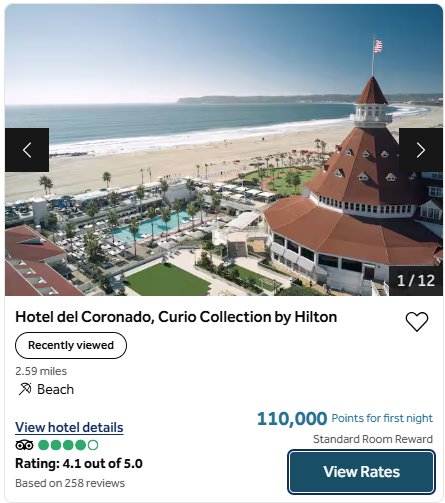
Running the math: $712 divided by 110,000 points works out to 0.65 cents per point — squarely in the middle of Hilton's standard redemption range, but below the 0.7-cent rule-of-thumb floor from the value table above. It's not a bad redemption by any means; the Del is a legitimately iconic beachfront property with a $700+ cash rate, and you're not paying resort fees on the points booking the way you would in cash. But it's also not the program's best use of points either — it's a fair trade, not a great one.
This is exactly the kind of redemption where the fifth night free benefit changes the math meaningfully. Book this same trip as five consecutive nights instead of four, and the fifth night — worth 110,000 points, or roughly $712 in cash-equivalent value — comes free. That single adjustment pushes the effective value from 0.65 cents per point across four nights to closer to 0.78 cents per point across five, moving the redemption from "below the floor" to a genuinely solid use of points. The lesson holds across the program: when a redemption is close to worth it, extending to five nights to capture the free night is often what tips it into clearly worth it.
Points & Money bookings let you combine a reduced points amount with a cash co-pay when you're short on a full redemption. The value here is mixed — in one documented example, a Points & Money booking that reduced the points cost by half required a cash payment nearly three times what the points alone would have been worth. Always run the math before assuming a Points & Money option is a good deal; it frequently isn't.
No blackout dates, ever. This bears repeating because it's a genuine structural advantage: if a standard room shows available for cash at any Hilton property, it's available for points at the same time. No program-imposed inventory restrictions, no "award seats not available" messaging that other loyalty programs are notorious for.
No resort fees on award stays. Hilton waives resort fees across the board on points redemptions — a benefit that can be worth $30 to $50 or more per night at the resort properties where Hilton points are otherwise their most valuable.
"Hilton's per-point value won't impress a Hyatt loyalist. But no blackout dates, no resort fees on awards, and fifth night free unlocking at the easiest elite tier in the industry is a different kind of value — built around flexibility rather than maximization."
Hilton vs Marriott vs Hyatt
The three-way comparison most points collectors eventually run, and the honest answer depends entirely on what you're optimizing for.
Hilton wins on accessibility and flexibility. Easiest elite status ladder of the three following the 2026 changes, no blackout dates ever, and fifth night free unlocking at Silver — the lowest elite tier — rather than being reserved for top-tier status the way comparable perks often are at other programs.
Marriott wins on breadth with better value. Comparable property count to Hilton but with meaningfully higher per-point value (0.7–0.9¢ versus Hilton's 0.4–0.6¢), plus Amex transfer access that Hilton simply doesn't offer.
Hyatt wins decisively on value, but loses on coverage. At 1.5–1.7 cents per point, Hyatt redemptions deliver close to three times what Hilton points are worth on average — but Hyatt's roughly 1,000 properties mean it's frequently not an option in markets where Hilton has a presence.
The practical takeaway: Hilton is the right program when convenience and certainty matter more than maximizing value per point. If you're booking somewhere Hyatt and Marriott don't reach, or you want the certainty of no blackout dates on a trip you can't be flexible about, Hilton delivers. If you're optimizing a finite points balance for maximum value, Hyatt should be your primary target, with Hilton filling in the geographic gaps.
What to Avoid
Transferring points to airlines. At 0.2 to 0.3 cents per point, this is consistently the worst use of Hilton points across the entire program. Keep points in hotels.
Booking budget properties without checking the math. A Hampton Inn redemption at 25,000–40,000 points against a $120–160 cash rate frequently delivers below 0.5 cents per point — sometimes well below. At Hilton's lower-tier properties, paying cash and earning points on the stay instead is often the better move.
Ignoring fifth night free. This is the single biggest value lever in the program, and it unlocks at Silver — the easiest elite tier to reach, free with the no-annual-fee Hilton card or just 10 nights of stays. If you're booking award stays without at least Silver status, you're leaving a 20% discount on the table. Structuring award stays in five-night increments once you have qualifying status is close to a mandatory move if you're holding a meaningful Hilton balance.
Points & Money without running the comparison. As shown above, these hybrid bookings can value your points well below their standard redemption rate. Always calculate what you're effectively paying per point before choosing this option over a standard award or paying cash outright.
Assuming Amex points can become Hilton points. They can't, directly. If your points strategy runs through Amex Membership Rewards, factor that into whether Hilton deserves a place in your hotel loyalty — earning has to come through Hilton co-branded cards or actual stays.
The Final Edit
Hilton Honors isn't trying to be the best per-point value in hotel loyalty, and it shouldn't be evaluated as if it were. What it offers instead is the largest property footprint among major chains, the easiest elite status to earn following the 2026 overhaul, and a fifth night free benefit that unlocks at the lowest elite tier in the program rather than being reserved for top-tier loyalists.
The 2026 changes make a real difference here. Gold status at 25 nights instead of 40, Diamond at 50 instead of 60, and a new Diamond Reserve tier with a genuinely differentiated guaranteed upgrade benefit — this is Hilton making a clear play for more loyal mid-tier travelers, and for moderate travelers who stay 25 to 50 nights a year, the math on chasing status just got considerably better.
The verdict: don't make Hilton your primary points strategy if per-point value is what you're optimizing for — Hyatt and even Marriott will get you further on the same spending. But don't dismiss the program either. For travelers who value certainty over maximization — no blackout dates, no resort fees on awards, status that's now genuinely achievable — Hilton Honors earns a real place in your wallet. Just go in knowing what you're trading: lower per-point value in exchange for the largest, most flexible hotel footprint in the industry.
Card benefits, fees, and offers are subject to change — always verify current terms directly with the issuer before applying. The Global Edit may earn a commission if you apply for a card or book through links on this site. This does not influence our recommendations or editorial verdict.
Editorial Disclosure: This article was written with the assistance of artificial intelligence and reflects the author's honest research, experience, and editorial judgment. AI-assisted content on The Global Edit is always reviewed, edited, and approved by our editorial team before publication.