Marriott Bonvoy is the largest hotel loyalty program on the planet. More than 30 brands. Over 10,000 properties. The Ritz-Carlton and St. Regis at the top, Fairfield and Courtyard at the bottom, and everything from W Hotels to Autograph Collection in between. If you've stayed in a hotel in the last five years, you've almost certainly slept under a Bonvoy-affiliated roof without realizing it.
That scale is the program's biggest selling point and its biggest problem. When a loyalty program spans this much territory, it has to serve everyone — the business traveler logging 100 nights a year at Marriott-branded airport properties, the leisure traveler eyeing a single splurge at the St. Regis Florence, and the points collector trying to extract maximum value from a currency that the program itself has made increasingly difficult to price with confidence.
The honest question for most travelers isn't whether to have a Bonvoy account — you should, because basic membership costs nothing and earns you points passively on stays you'd take anyway. The real question is whether Bonvoy deserves your active loyalty: your card spend, your deliberate hotel choices, your strategic accumulation. That's a more complicated answer, and it depends almost entirely on how you travel and how you plan to use what you earn.
This guide gives you the full picture — what Bonvoy points are actually worth in 2026, the legitimately good redemptions, the traps, the elite status tiers that matter versus the ones that don't, and the direct comparison to World of Hyatt that every serious hotel points collector needs to make.
What Is Marriott Bonvoy
Marriott Bonvoy launched in 2019 as the unified successor to three legacy programs — Marriott Rewards, Starwood Preferred Guest (SPG), and The Ritz-Carlton Rewards — after Marriott's 2016 acquisition of Starwood Hotels. The merger created a portfolio that remains unmatched in size: roughly 10,000 properties across 30+ brands in over 140 countries.
Properties: 10,000+ worldwide across 30+ brands
Points currency: Marriott Bonvoy Points
Points value: ~0.7–0.9 cents each on average
Award pricing: Fully dynamic — no fixed chart
Points expiration: 24 months of inactivity
Elite tiers: Silver (10 nights), Gold (25), Platinum (50), Titanium (75), Ambassador (100 nights + $23,000 spend)
Free membership: Yes — no annual fee to join
The breadth of the portfolio is genuine. Bonvoy covers budget-to-luxury in almost every major market in the world. That's meaningfully different from World of Hyatt, which has around 1,000 properties and significant geographic gaps. If you travel frequently to destinations where Hyatt has thin coverage — most of Southeast Asia, much of Africa, large swaths of Latin America — Bonvoy is often the only realistic hotel points option.
That said, more properties doesn't mean better value per point. The two things are separate questions, and conflating them is how people end up with large Bonvoy balances that quietly disappoint them on redemption.
What Bonvoy Points Are Actually Worth
Here's the number that governs everything else: in 2026, Marriott Bonvoy points are worth approximately 0.7 to 0.9 cents each for typical hotel redemptions. Independent analysis tracking real-world redemptions puts the median observed value at roughly 0.77–0.8 cents per point.
That baseline is lower than most other major travel currencies. Chase Ultimate Rewards points, Amex Membership Rewards, and Citi ThankYou Points all carry valuations above 1.5 cents each when used well. Even Delta SkyMiles, which has its own valuation challenges, benchmarks slightly above Bonvoy on average.
"A Bonvoy point is worth less than a cent on average — but the ceiling at luxury properties, and with the fifth night free, can push that number meaningfully higher."
What saves Bonvoy from being a bad program is that the ceiling is meaningfully above the average. At luxury properties with strong cash rates — the St. Regis Rome, the W Maldives, the Ritz-Carlton Maui — points can deliver over 1.1 cents each, particularly when paired with the fifth-night-free benefit on longer stays (more on that below). The gap between the average redemption and the best redemption is the real story of how to use Bonvoy in 2026.
Bonvoy also uses fully dynamic pricing — there is no published award chart, and the number of points required for any given night moves in real time based on cash demand, seasonality, and occupancy. Award nights start at around 12,000 points per night at the most affordable properties and can reach 150,000 points or more per night at peak-demand luxury resorts. This makes it genuinely difficult to set expectations without searching for your specific dates and property.
One important expiration note: Bonvoy points expire after 24 months of account inactivity. Unlike Delta SkyMiles (which never expire) or World of Hyatt (which resets on activity), letting your Bonvoy account go dormant will cost you your balance. Any earning or redemption activity — including credit card spend on a co-branded Bonvoy card — resets the clock.
How to Earn Bonvoy Points
Marriott's own page describes earning as up to 10 points per $1 on hotel stays, with additional earning on dining, spa, golf, and meetings at participating properties. In practice, the base earning rate for standard members is around 10 points per $1 on room rates, with elite members earning bonus points on top.
At Marriott hotels: Base members earn 10 points per $1 on eligible hotel charges including room rate, dining, and spa spend charged to the room. Elite members earn a bonus percentage on top of that — 10% more for Silver, 25% more for Gold, 50% more for Platinum, and 75% more for Titanium and Ambassador.
Through Bonvoy co-branded credit cards: This is where most non-frequent-travelers accumulate the bulk of their points. Marriott has co-branded cards issued by both Chase and American Express. The main consumer cards are the Marriott Bonvoy Boundless (Chase), the Marriott Bonvoy Bold (Chase), the Marriott Bonvoy Bevy (Amex), and the Marriott Bonvoy Brilliant (Amex). Each earns Bonvoy points on everyday spend, typically at 2–6x on Marriott purchases and 2–3x on dining and travel, with 1–2x on everything else.
Through transfer partners: This is where the math gets interesting — and where Bonvoy's position in the broader points ecosystem matters.
Three major flexible points programs transfer into Marriott Bonvoy:
- Amex Membership Rewards → Bonvoy at 1:1.2 (the best inbound ratio — 1,000 Amex points become 1,200 Bonvoy points)
- Chase Ultimate Rewards → Bonvoy at 1:1 (straightforward, but rarely the best use of Chase points)
- Bilt Rewards → Bonvoy at 1:0.5 (poor ratio — rarely justified)
The important caveat: in most cases, your Amex or Chase points are worth more in other programs. Transfer to Bonvoy only when you have a specific redemption in hand that pencils out — not speculatively.
One more reason to watch Chase UR transfer bonuses closely: Chase periodically runs limited-time transfer bonuses to Marriott Bonvoy — and they can be significant. As of June 2026, Chase is offering a 55% bonus on UR-to-Bonvoy transfers, meaning every 1,000 Chase points becomes 1,550 Bonvoy points. That's the highest bonus we've seen from Chase to Marriott. It won't be available indefinitely, and it doesn't make speculative transfers wise — but if you have a specific Bonvoy redemption in hand, this window meaningfully changes the math. Hyatt, by comparison, has never offered a transfer bonus of this magnitude through Chase UR.

Through Bonvoy's dining program and various travel and lifestyle partners, members can also earn points without a hotel stay. Hertz car rentals earn up to 700 points, and select airline partners allow miles-to-points transfers at a 1:1 ratio with Air Canada Aeroplan.
How to Redeem Bonvoy Points
The primary use case is straightforward: redeem points for free hotel nights at any of Bonvoy's 10,000+ participating properties. Since pricing is dynamic, the number of points required varies by property, date, and demand — but awards start at around 12,000 points per night at entry-level properties and scale up from there.
The best redemptions are at properties where the cash rate is high and the points price is relatively modest. The St. Regis Rome, for example, regularly commands cash rates above $700 per night. When points pricing on those same dates falls in the 60,000–80,000 range, you're getting above 0.9 cents per point — solidly above the average. At a Courtyard in a secondary city where cash rates run $130, 20,000 points gives you 0.65 cents — fine, but not exciting.
Beyond hotel nights, Bonvoy offers several other redemption paths — though most of them deliver worse value than hotel stays:
Marriott Bonvoy Moments, the program's experiences platform, lets members use points for concerts, culinary events, sporting events, and VIP access. The per-point value on these typically runs around 0.4 cents — significantly below what you'd get on a hotel stay. Unless a specific experience is genuinely unavailable for cash and you have a surplus of points, this is not a compelling use.
Cash + Points is a hybrid redemption where you pay a lower points amount alongside a cash co-pay. This can occasionally make sense when you're short on points for a specific booking, but the effective per-point value is usually no better than a straight points redemption and sometimes worse.
PointSavers offers discounts of up to 20% off standard award pricing at participating properties. This is worth checking when you're searching — the same stay that prices at 60,000 points might show a PointSavers rate of 48,000 points — but availability is limited and property selection rotates.
Not all redemptions are equal. Here's how the options stack up, best to worst:
The rule of thumb: if a redemption pencils out below 0.7 cents per point, you're better off paying cash and saving your points for a stronger opportunity.
Always check both the standard award price and any PointSavers rate when searching Bonvoy redemptions. The discount isn't available everywhere, but when it appears, it's free savings — the room and experience are identical. Filter for "Use Points/Awards" in the search and look for the PointSavers label on qualifying properties.
The Fifth Night Free Benefit
This is Bonvoy's single most valuable redemption feature, and it's worth understanding precisely how it works because it changes the math on longer stays considerably.
When you book an award stay of five or more consecutive nights, the fifth night is free. You pay points for nights one through four, night five costs zero, and you pay points again from night six onward on the same pattern. On a five-night stay, you're effectively getting a 20% discount on the total points cost. On a ten-night stay, you get two free nights — a 20% discount overall.
A concrete example: the W Maldives at a cash rate of roughly $1,200 per night might price at around 90,000 Bonvoy points per night on a typical date. A five-night stay would normally cost 450,000 points. With the fifth night free, it costs 360,000 points — a savings of 90,000 points, which at 0.8 cents each represents roughly $720 in value.
The fifth-night-free benefit is available to all Bonvoy members — you don't need elite status to access it. It applies to standard award redemptions and also to PointSavers rates where available. The one requirement: all five nights must be booked as a single reservation at the same property.
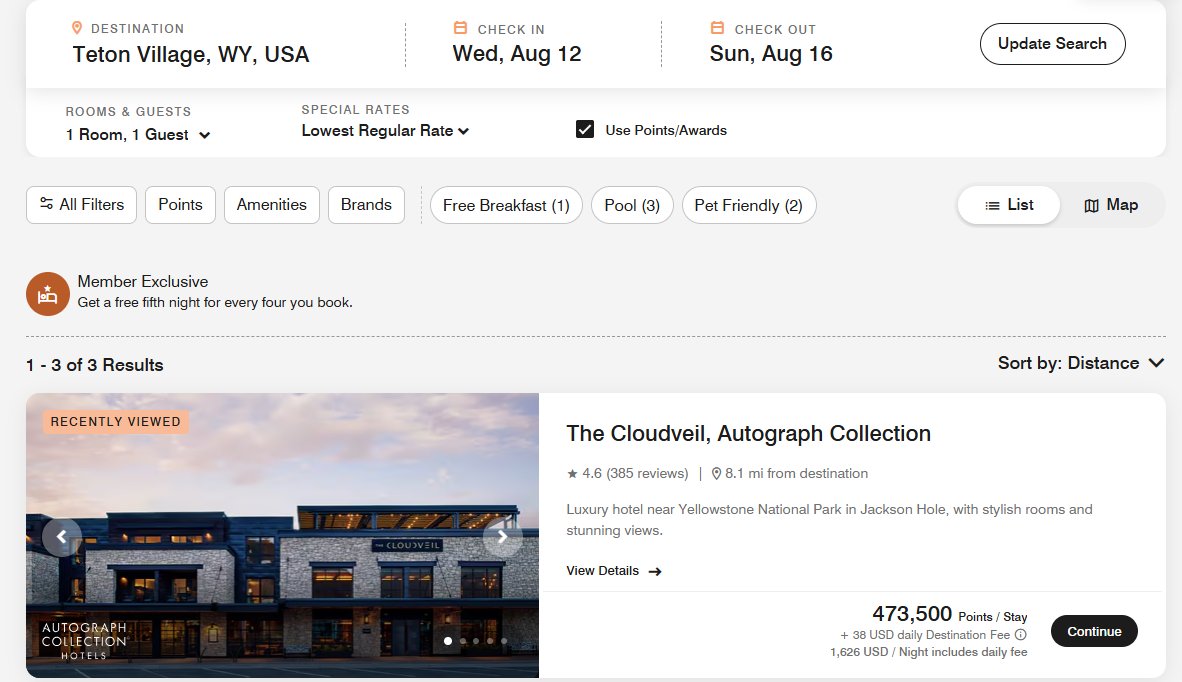
A real-world example: The Cloudveil, Autograph Collection in Teton Village, Wyoming — a luxury property minutes from Jackson Hole Mountain Resort — prices at 473,500 points for a four-night award stay in August, or roughly 118,375 points per night. The cash rate for the same dates runs $1,626 per night. That works out to 1.37 cents per point — well above the Bonvoy average and exactly the kind of high-cash-rate redemption the program rewards. Add a fifth night and that free night saves you another 118,375 points — roughly $1,626 in value at cash-equivalent rates.
If you're planning a longer stay at a single property, structure your booking to take advantage of this. A four-night stay and a five-night stay at identical nightly pricing have very different effective costs per night.
Elite Status - What Each Tier Gets You
Marriott Bonvoy has five elite tiers, earned through qualifying nights per calendar year. Here's what each one actually delivers:
A few notes on what the table doesn't fully capture. Silver is barely worth mentioning — 10 nights and a 10% points bump is a participation trophy, not a loyalty reward. Gold is the first tier that actually changes your experience: the guaranteed 2pm checkout is genuinely useful on any travel day. Platinum at 50 nights is where Bonvoy starts to compete — lounge access and the welcome gift (choose between bonus points, a breakfast offering, or an amenity) add up over multiple stays. Titanium and Ambassador reward travelers who are essentially living in Marriott properties, with Ambassador's Your24 benefit — choose your own check-in time and keep the room until the same hour on departure — being the single most practical elite perk in the whole program for long-haul travelers.
The honest caveat on upgrades across all tiers: Marriott's upgrade delivery is inconsistent. "Subject to availability" means different things at different properties, and unlike World of Hyatt's Globalist confirmed suite upgrades, Bonvoy upgrades are never guaranteed until check-in.
Bonvoy co-branded credit cards offer elite night credits that count toward status. The Marriott Bonvoy Boundless card (Chase) provides 15 elite night credits annually, and the Marriott Bonvoy Brilliant (Amex) provides 25 elite night credits. If you're naturally sitting at 35 stays per year, the Brilliant card's 25 credits push you to Platinum without a single additional night. Factor card credits into your status math before assuming a target tier is out of reach.
Bonvoy vs Hyatt - Which Program Wins
This is the question most serious hotel points collectors eventually ask, and the honest answer is that both programs have distinct advantages — they're solving for different travelers.
Hyatt wins on per-point value. World of Hyatt still uses a largely fixed award chart for most properties, which makes it possible to identify great redemptions in advance and plan around them. Hyatt points are consistently valued above Bonvoy — typically 1.5–2 cents each on a well-planned redemption versus Bonvoy's 0.7–0.9 cent average. The Andaz Maui at Wailea is a Category 8 property redeemable for 35,000–75,000 points per night depending on dates. A comparable luxury Bonvoy property at equivalent cash rates might require 80,000–120,000 dynamic-priced points for the same night.
Hyatt wins on elite status benefits. Hyatt Globalist — earned at 60 qualifying nights — includes confirmed suite upgrades (not subject to availability), complimentary breakfast, club lounge access, waived resort fees on award stays, and free parking. Bonvoy's Platinum at 50 nights offers inconsistent upgrade delivery and a welcome gift choice. Globalist is one of the most generous top-tier statuses in the hotel industry. Bonvoy's equivalent requires 75 nights for Titanium and 100 nights for Ambassador.
Bonvoy wins on property coverage. This is not a close comparison. 10,000 Bonvoy properties versus roughly 1,000 Hyatt properties means Bonvoy is bookable in markets where Hyatt simply has no presence. If your travel takes you to Bali, Nairobi, São Paulo, or most of Southeast Asia, Bonvoy is probably your hotel program by default.
Bonvoy wins on credit card earning. The Marriott co-branded cards have broad issuer coverage through both Chase and Amex, with welcome bonuses that can deliver large point balances quickly. Hyatt's primary co-branded card is issued only through Chase, limiting accumulation paths.
The practical conclusion for most readers: if you have the choice, build Hyatt points for hotel redemptions and use World of Hyatt as your primary hotel loyalty program. But keep a Bonvoy account active for the properties and destinations Hyatt doesn't cover — which is a lot of the world.
The Airline Transfer Question
Bonvoy points transfer to more than 40 airline partners, which sounds appealing until you examine the math. The transfer ratio is 3 Bonvoy points to 1 airline mile. For every 60,000 Bonvoy points you transfer, most airlines give you 20,000 miles plus a 5,000-mile bonus — effectively 25,000 miles total.
That means you're converting points worth roughly 0.8 cents each into airline miles at an effective rate that usually comes out below 0.5 cents per Bonvoy point. Unless the specific airline mileage redemption you're targeting is exceptionally valuable — a business class redemption delivering well above 2 cents per mile — transferring Bonvoy to airlines is nearly always a poor use of your points.
The United exception is worth noting: United MileagePlus gets 10,000 bonus miles (rather than 5,000) per 60,000 Bonvoy points transferred, making the effective ratio slightly better. That said, the math still rarely beats keeping your Bonvoy balance for hotel redemptions.
Three airlines do NOT receive the standard 5,000-mile bonus when you transfer 60,000 Bonvoy points: American AAdvantage, Avianca LifeMiles, and Delta SkyMiles. United MileagePlus, by contrast, receives a larger 10,000-mile bonus. Check the current bonus structure before initiating any transfer — it can change, and the math matters.
The general rule: Bonvoy points belong in hotels. Transfer to airlines only in specific situations where you need to top up a particular airline balance for a high-value redemption you've already confirmed is available.
The Final Edit
Marriott Bonvoy is a program worth having, but not one worth centering your entire travel strategy around.
If your travels take you to destinations where Hyatt doesn't reach — and increasingly, that describes most of the world outside North America and major European cities — Bonvoy is indispensable. The portfolio breadth is real. The W Maldives, the St. Regis Rome, the Ritz-Carlton Tokyo: these are Bonvoy properties that have no Hyatt equivalent, and they deliver legitimate value on longer award stays, especially with the fifth-night-free benefit doing its work.
But if you're an active points optimizer with a choice of where to direct your hotel loyalty, Hyatt remains the stronger per-point program. The fixed award chart, the Globalist benefits, and the consistent suite upgrade delivery make Hyatt a more predictable and rewarding primary program for the traveler who spends meaningfully on hotels. Bonvoy's dynamic pricing and inconsistent elite benefit delivery mean you're working harder for comparable outcomes.
The smart play in 2026 is to treat Bonvoy as your broad-coverage program — earn passively through a co-branded card, use the points strategically on longer luxury stays where the fifth night free moves the math, and keep the account active. For destinations where Hyatt has strong presence and you're choosing between programs, direct your stays there. For everywhere else — Southeast Asia, much of Africa and Latin America, properties the size and prestige of which Hyatt simply can't match — Bonvoy is the answer.
The world's biggest hotel program isn't the world's best hotel program. But it covers enough of the world that you'd be poorer without it.
Card benefits, fees, and offers are subject to change — always verify current terms directly with the issuer before applying. The Global Edit may earn a commission if you apply for a card or book through links on this site. This does not influence our recommendations or editorial verdict.
Editorial Disclosure: This article was written with the assistance of artificial intelligence and reflects the author's honest research, experience, and editorial judgment. AI-assisted content on The Global Edit is always reviewed, edited, and approved by our editorial team before publication.