Most people think of United MileagePlus as a program for people who fly United. That's understandable — it's United's program, co-branded cards put United miles in your wallet, and the name itself points you toward the airline. But it's a limiting way to think about what MileagePlus actually is.
United is a founding member of Star Alliance, the world's largest airline alliance with 26 member carriers. That means every mile sitting in your MileagePlus account can book seats on ANA, Lufthansa, Singapore Airlines, Swiss International, TAP Air Portugal, Turkish Airlines, EVA Air, Air New Zealand, and more. When you know how to use it, MileagePlus isn't a program for flying United. It's a program for flying the world.
That said, MileagePlus has genuine complexity — dynamic pricing with no published award chart, two award tiers with meaningfully different availability, a partner flight premium that catches people off guard, and a transfer partner list so narrow (just Chase and Bilt) that it's easy to underestimate. Getting good value out of MileagePlus requires knowing the rules. This guide covers all of them.
What MileagePlus Actually Is
United MileagePlus is United Airlines' frequent flyer program and one of the two most useful airline programs in the Chase Ultimate Rewards ecosystem. It's also one of the most powerful Star Alliance ticketing programs for U.S.-based travelers — a distinction that matters more than most people realize.
Alliance: Star Alliance (26 member airlines)
Miles value: ~1.2–1.35 cents each on average; up to 1.7¢+ on premium sweet spots
Award pricing: Dynamic — no published chart; Saver and Everyday tiers
Award calendar: Opens 337 days in advance
Miles expiration: 18 months of account inactivity
Transfer partners in: Chase Ultimate Rewards (1:1), Bilt Rewards (1:1)
No carrier surcharges: United does not pass on fuel surcharges for most partner awards
Elite tiers: Premier Silver, Gold, Platinum, 1K
Free membership: Yes
The Star Alliance network is the program's real asset. Member airlines cover virtually every major market in the world — Europe through Lufthansa, SWISS, Austrian, TAP, and LOT; Japan and Asia through ANA and Singapore Airlines; Southeast Asia through Thai Airways and EVA Air; Latin America through Avianca and Copa; Australia through Air New Zealand. The United hub network — Newark, Chicago O'Hare, Denver, Houston, San Francisco, Los Angeles, Washington Dulles — connects cleanly to this global footprint, which is why MileagePlus works better for many travelers than programs with a narrower alliance.
One 2026 update worth knowing: ITA Airways (Italy's flag carrier, formerly Alitalia) is in the process of joining Star Alliance this year, which will eventually expand the program's European coverage. And the United-JetBlue partnership, which launched award earning and redemption in October 2025, now includes reciprocal elite benefits as of April 2026 — a meaningful development for east coast travelers who split time between the two carriers.
What United Miles Are Worth
The honest baseline: United MileagePlus miles are worth approximately 1.2 to 1.35 cents each for typical redemptions, based on independent analysis of real-world award bookings in 2026. That's a solid midpoint for a major airline program — well above Marriott Bonvoy points (~0.8¢) and Delta SkyMiles (~1.1¢), but below the ceiling you can reach with Hyatt (~1.7¢) or well-executed Amex or Chase transfers to premium partners.
The spread between average and best is wide. On domestic short-haul routes and economy redemptions, value often lands at 1.1–1.2 cents. On Polaris business class to Europe or ANA business class to Japan — the program's genuine sweet spots — well-timed Saver awards can deliver 1.7 cents or better per mile.
One important note on expiration: MileagePlus miles expire after 18 months of account inactivity. Any earning activity — flying, credit card spend, shopping portal purchases, dining partners — resets the clock. This is a shorter expiration window than Delta (never expires) and comparable to American AAdvantage (24 months). Keep your account active, even modestly.
Saver vs Everyday Awards - The Most Important Distinction
MileagePlus has no published award chart, but it operates two award pricing tiers: Saver and Everyday. Understanding the difference is the single most important piece of knowledge for using the program well.
Saver awards are the lower-priced tier. They represent the cheapest available award pricing for a given route and cabin. Saver inventory is capacity-controlled — United releases a limited number of seats per flight at Saver pricing — which means it's not always available and is more likely to be found well in advance (or occasionally in close-in inventory releases).
Everyday awards have higher availability but cost meaningfully more miles. The price difference can be substantial — sometimes 30 to 50 percent more miles for the same route and cabin. Redeeming at Everyday pricing is generally a poor use of miles. The effective per-mile value drops, often below 1.0 cent, which means you'd be better off paying cash.
"Saver inventory is the whole game in MileagePlus. If you can't find Saver pricing on the route you want, it's worth asking whether you should use miles at all — or whether a different program has better availability for the same flight."
The practical implication: only redeem MileagePlus miles at Saver pricing. If the only availability showing is Everyday, check whether Air Canada Aeroplan, Avianca LifeMiles, or ANA Mileage Club can book the same United-operated flight at a better rate through their own award programs. More on this in the partner booking section below.
United's award calendar opens 337 days in advance — one of the shorter windows among major programs. For the most in-demand routes and dates, searching early matters. Flexibility on dates matters too: the calendar view on united.com shows pricing across multiple days simultaneously, and adjacent dates can vary significantly.
United cardholders get access to expanded Saver award inventory (the XN booking class) that non-cardholders can't see. If you're planning a United or Star Alliance redemption, logging in with a United co-branded card account — even the no-annual-fee United Gateway card — unlocks additional Saver seats on United-operated flights that don't appear for general members. This alone can make a co-branded card worth holding.
The Sweet Spots Worth Knowing
Despite the lack of a published award chart, MileagePlus has observable Saver pricing baselines that hold consistently across most routes. These are the redemptions that deliver the best value.
Polaris business class to Europe: ~60,000–80,000 miles one-way. United's Polaris business class is a legitimately competitive transatlantic product — reverse-herringbone seats, direct aisle access from every seat, proper bedding, and a solid dining program. At Saver pricing around 60,000 to 80,000 miles one-way, a cash-equivalent fare of $3,000+ delivers well above 2 cents per mile on a premium cabin redemption. This is one of the most consistent high-value uses of MileagePlus miles in the entire program.
Star Alliance business class to Europe (partner carriers): ~80,000 miles one-way. Booking Lufthansa, SWISS, Austrian Airlines, or LOT Polish Airlines business class through MileagePlus typically prices at around 80,000 miles one-way — the same ballpark as United's own Polaris, and without the carrier-imposed surcharges that make some European programs expensive. Lufthansa and SWISS business class are among the strongest transatlantic products in the market; booking them through MileagePlus rather than Lufthansa's own miles program (which are harder to accumulate) is a genuine strategic advantage.
ANA business class to Japan: ~75,000–80,000 miles one-way. ANA's business class product — The Room on long-haul widebodies — is one of the best in commercial aviation. Closed-door suites, 6-foot flat beds, exceptional Japanese service. Booking it through MileagePlus at Saver pricing is one of the program's best redemptions. Crucially, ANA's own Mileage Club only allows round-trip partner awards — which means United is one of the few programs where you can book ANA business class one-way, giving you routing flexibility that ANA itself doesn't.
Intra-Europe economy: ~8,000 miles one-way. Short flights within Europe on Star Alliance carriers (Lufthansa Frankfurt-Munich, SWISS Zurich-London, TAP Lisbon-Madrid) consistently price at around 8,000 miles one-way in economy. These are positioning flights — getting from one European city to your main destination — and at 8,000 miles against fares that routinely run $150–$200, you're getting 1.9–2.5 cents per mile. One of the most overlooked sweet spots in the program.
Domestic short-haul: from ~5,000–12,500 miles one-way. The cheapest domestic awards on United start around 5,000 miles for very short hops and commonly price at 12,500 miles one-way for standard domestic routes at Saver pricing. Against cash fares of $150–$300, this is acceptable but not exceptional value. Better uses of miles exist for international travel, but domestic Saver awards are fine for clearing a balance or booking a trip where the cash price spikes.
Real-World Example: DFW to LAX
Here's what domestic Saver pricing looks like in practice. A one-way economy flight from Dallas/Fort Worth to Los Angeles on United prices at 15,000 miles for most dates in the fall window, against a cash fare of $193. That works out to 1.29 cents per mile — above the 1.2¢ target floor and a legitimate use of Saver miles when the cash fare is this high.
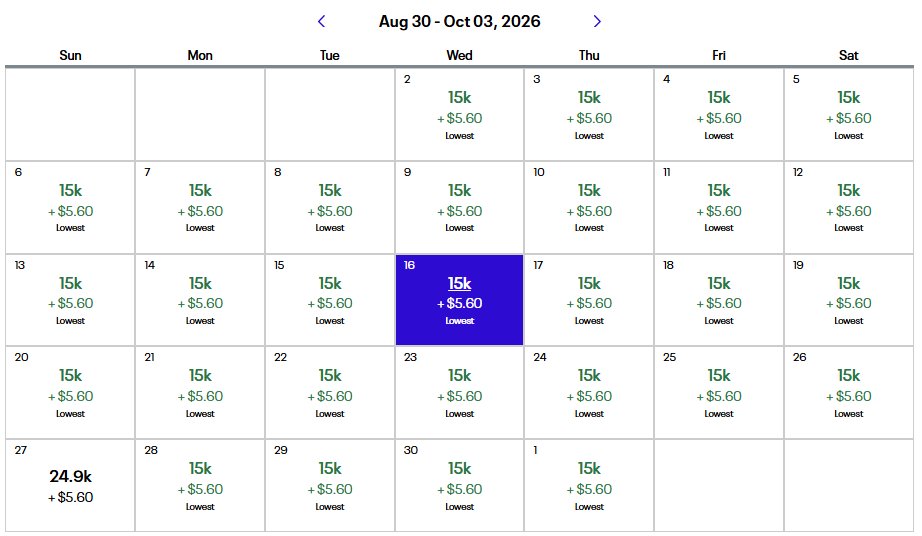
Notice how consistent the pricing is across nearly every date in the window — 15k miles plus $5.60 in taxes, labeled "Lowest" across the board, with only Sunday October 27 spiking to 24.9k. That's dynamic pricing working in your favor on a route with consistent United capacity. One Sunday outlier doesn't change the value of the other 30+ dates.
Use the "Show Calendar" feature on united.com when searching award flights. Instead of checking one date at a time, the calendar view surfaces award pricing across a 5-week window simultaneously — making it easy to spot the cheapest dates, avoid pricing spikes (like that Sunday outlier above), and compare options at a glance. It's the fastest way to find consistent Saver availability on any route.
Real-World Example: DFW to Munich
The transatlantic picture looks different. A one-way economy flight from Dallas/Fort Worth to Munich on Star Alliance metal prices at 40,000 miles for most dates in the September–October window, against a cash fare of $456. That's 1.14 cents per mile — acceptable for a transatlantic economy seat, but not the program's best return.
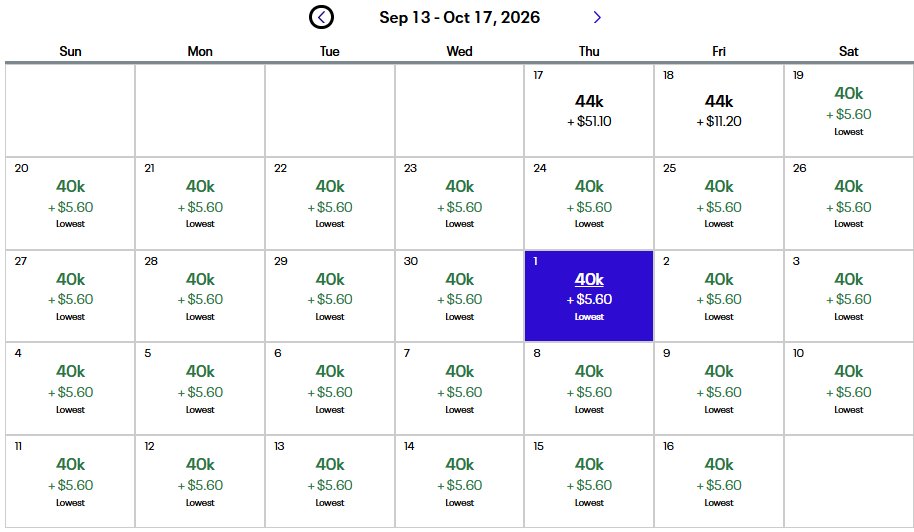
The calendar shows most dates at a consistent 40k miles plus $5.60 in taxes — with a couple of dates in mid-September showing 44k miles and higher fees ($51.10 and $11.20 respectively). The lesson: September 17–18 dates aren't worth redeeming for. The October dates at 40k and $5.60 are the right call. The same calendar tool that surfaces the DFW–LAX sweet spot makes this comparison obvious at a glance.
The more important point on this route: 40,000 miles for a transatlantic economy seat is the Saver floor. The same seat in Polaris business class on United metal or Lufthansa would cost 60,000–80,000 miles. If you're going to spend miles on a transatlantic trip, the business class cabin delivers 1.7–2.0+ cents per mile — significantly better value than economy at 1.14 cents. The math favors saving more miles for the upgrade rather than spending them on economy.
The Excursionist Perk
This is one of the most underused features in the MileagePlus program, and it's a legitimate differentiator from most other airline programs.
When you book a round-trip or multi-city international award with three or more one-way segments, one qualifying leg within a region is free. United calls it the Excursionist Perk. In practice, it means you can add a positioning flight, a side trip, or a city-to-city connection within the same broad region at zero additional miles cost.
A concrete example: you're booking a round trip from New York to Tokyo. Your itinerary might look like New York → Tokyo → Osaka → New York. The Tokyo-Osaka leg — which would normally cost miles — is free under the Excursionist Perk because it falls within the same region (Japan/Northeast Asia) on a qualifying multi-segment award.
Requirement: Round-trip or multi-city international award with 3+ one-way segments
What's free: One qualifying one-way flight entirely within a region on the outbound journey
Best use cases: Adding a positioning flight within Europe (e.g. London → Paris on a transatlantic trip), adding a domestic Japan leg to a Tokyo award, adding a city-to-city connection within Latin America
Key limitation: The free leg must be within a single region as defined by United's zone map — it can't cross regions
How to book: United.com multi-city search; the free leg prices at zero miles automatically when the perk applies
For travelers planning multi-city European trips or Japan itineraries, the Excursionist Perk materially changes the miles math. A Tokyo-Osaka leg or a London-Rome positioning flight that would cost 8,000–12,000 miles as a standalone award becomes free when structured as part of a qualifying international round trip.
How to Earn United Miles
Flying United and partner airlines is the primary earning method for frequent travelers. United restructured its earning rates effective April 2, 2026 — a meaningful change that rewards cardholders and elite members significantly more than general members. Miles earned are based on the dollar amount paid for the ticket, not by distance flown.
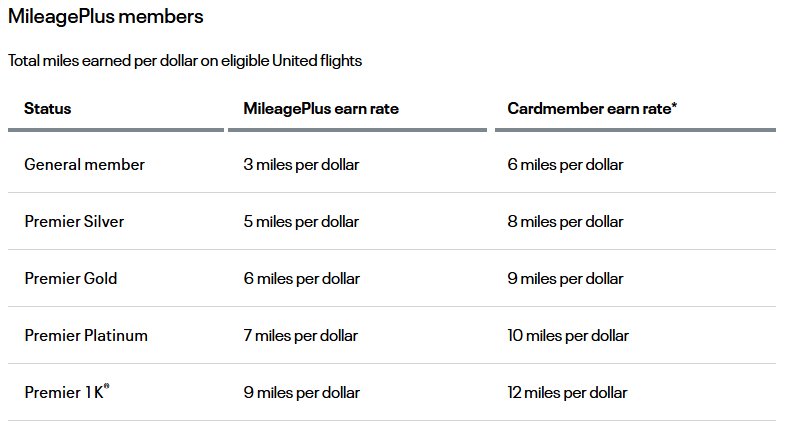
The structure as of April 2026: general members earn 3 miles per dollar on eligible United flights, rising to 9 miles per dollar for Premier 1K members. Holding a United co-branded card doubles the return — cardmembers at the general level earn 6 miles per dollar, and Premier 1K cardmembers earn 12 miles per dollar. Basic Economy fares without a co-branded card earn zero miles, which is a meaningful caveat for price-sensitive bookings.
United co-branded credit cards are the main earning path for non-frequent flyers and the most practical way to build a MileagePlus balance. United issues several Chase co-branded cards:
The United Gateway (no annual fee) earns 2x on United purchases, 2x on dining and hotels, 1x everywhere else. Minimal perks but a free entry point.
The United Explorer ($95/year) earns 2x on United, dining, and hotels, 1x elsewhere, and includes a free checked bag on United flights, priority boarding, and 2 United Club one-time passes per year. The most practical choice for occasional United flyers.
The United Quest ($250/year) earns 3x on United, 2x on dining, select travel, and streaming, 1x elsewhere. Includes $125 in annual United credits, 2 checked bags, 5,500 bonus miles each account anniversary, and PlusPoints for upgrades. The math works for travelers who fly United several times per year.
The United Club Infinite ($525/year) earns 4x on United, 2x on travel and dining, includes United Club lounge membership, 2 checked bags, and premier upgrade priority. Justifiable for frequent United flyers who value lounge access.
Transfer partners — Chase and Bilt. This is a critical distinction from Amex and Capital One ecosystems: neither Amex Membership Rewards nor Capital One Miles transfer to United MileagePlus. Only Chase Ultimate Rewards and Bilt Rewards transfer to United, both at a 1:1 ratio.
Transfer Partners - Chase and Bilt Only
<function_calls>
The narrow transfer partner list is the most underappreciated constraint in MileagePlus. If your primary rewards currency is Amex Membership Rewards or Capital One Miles, United is not accessible as a transfer destination — you'd need to go through ANA Mileage Club, Singapore KrisFlyer, or Avianca LifeMiles (all of which transfer from Amex and Capital One) to book United-operated flights through the partner booking route.
For Chase Ultimate Rewards holders, MileagePlus is one of the most natural transfer destinations. Chase transfers 1:1 instantly, and the combination of Chase Sapphire Reserve or Preferred earning with MileagePlus Saver award availability gives you a direct pipeline from everyday spending to premium cabin international travel.
Chase points are worth 2.0+ cents each by most independent valuations — meaning transferring to United (where miles are worth ~1.3 cents) is technically a step down in average currency value. This isn't a reason to never transfer; it's a reason to only transfer when you have a specific, confirmed Saver award in hand that justifies the exchange. Run this check before every transfer:
- Confirm Saver availability is showing for your exact route, dates, and cabin
- Calculate the cash cost of the same ticket
- Divide cash cost by miles required — if you're at 1.3 cents per mile or better, the transfer makes sense
- Remember: transfers are irreversible. Never transfer speculatively
Bilt Rewards is the other transfer path into MileagePlus and particularly valuable for renters. Bilt's primary card (the Bilt Mastercard) earns points on rent payments — typically a dead category for rewards earning — at zero transaction fees. Those points transfer 1:1 to United, making Bilt one of the most efficient ways to accumulate United miles for people who rent rather than own. Bilt also transfers to Hyatt, American Airlines, Air Canada, and others, which gives it flexibility beyond United alone.
One hotel program worth mentioning: Marriott Bonvoy transfers to United at a 3:1 ratio with a 10,000-mile bonus per 60,000 Bonvoy points transferred. The effective math improves the 3:1 ratio slightly, but hotel-to-airline transfers remain a poor use of hotel points in most cases. Use this only to top off a MileagePlus account when you're short by a small amount for a confirmed award.
When to Book Through a Partner Instead
Here's something MileagePlus users frequently overlook: other Star Alliance programs often price the same United-operated flights at fewer miles than United charges you directly. Before transferring Chase points to United, it's worth checking whether a different program offers better availability or pricing for your specific route.
The most relevant alternatives for U.S.-based travelers:
Air Canada Aeroplan transfers from Amex, Chase, Capital One, and Bilt at 1:1. It uses a distance-based award chart and frequently prices transatlantic business class at 70,000 miles — versus 80,000 on United — for the same Lufthansa or SWISS seat. Aeroplan also has more generous stopover rules than MileagePlus and often surfaces award availability that United's own search doesn't display. A real competitor worth checking on any transatlantic booking.
Avianca LifeMiles transfers from Amex, Citi, and Capital One at 1:1. It provides access to United and Star Alliance flights at rates that are often competitive with MileagePlus Saver pricing and occasionally better. LifeMiles is particularly useful for domestic U.S. short-haul on United — flights that might cost 12,500 MileagePlus miles can price at 7,500 LifeMiles — and for Lufthansa first class, where LifeMiles charges 120,000 miles one-way with low taxes.
ANA Mileage Club transfers from Amex, Virgin Atlantic, and others (not directly from Chase). As noted above, ANA only allows round-trip partner awards — so it's not the right tool for one-way redemptions. But on round-trip bookings, ANA's fixed regional award chart can price transatlantic routes significantly cheaper than United's dynamic Saver pricing.
Singapore KrisFlyer transfers from Amex, Chase, Citi, and Capital One at 1:1. It can book United-operated flights to Hawaii or short domestic segments at rates marginally below what MileagePlus charges for the same Saver award.
Before transferring any points to MileagePlus, search the same route in Air Canada Aeroplan and Avianca LifeMiles. Both access United award space, both transfer from Chase at 1:1, and both frequently price the same seats at fewer miles. The one-stop workflow: confirm the United flight is showing Saver availability on united.com, then check Aeroplan and LifeMiles for the same route before deciding which program to book through.
Partner awards booked through United carry a ~10% premium over United-operated flights — meaning a United-metal transatlantic business class award at 60,000 miles becomes 66,000 miles if you're flying Lufthansa metal on the same routing. This is worth factoring into your math when comparing options.
One major advantage United holds over several European programs: no carrier-imposed surcharges on most partner awards. Programs like British Airways Avios pass on hundreds of dollars in fuel surcharges when you book Lufthansa or other partners. United does not impose these fees for most partner carriers, making a United-booked Lufthansa or SWISS ticket meaningfully cheaper in out-of-pocket costs than the same booking through some other programs.
Elite Status - Is It Worth Chasing
United's Premier elite tiers — Silver, Gold, Platinum, and 1K — follow a qualification system based on Premier Qualifying Points (PQP) earned through flying and credit card spend, and Premier Qualifying Flights (PQF), a minimum flight count threshold.
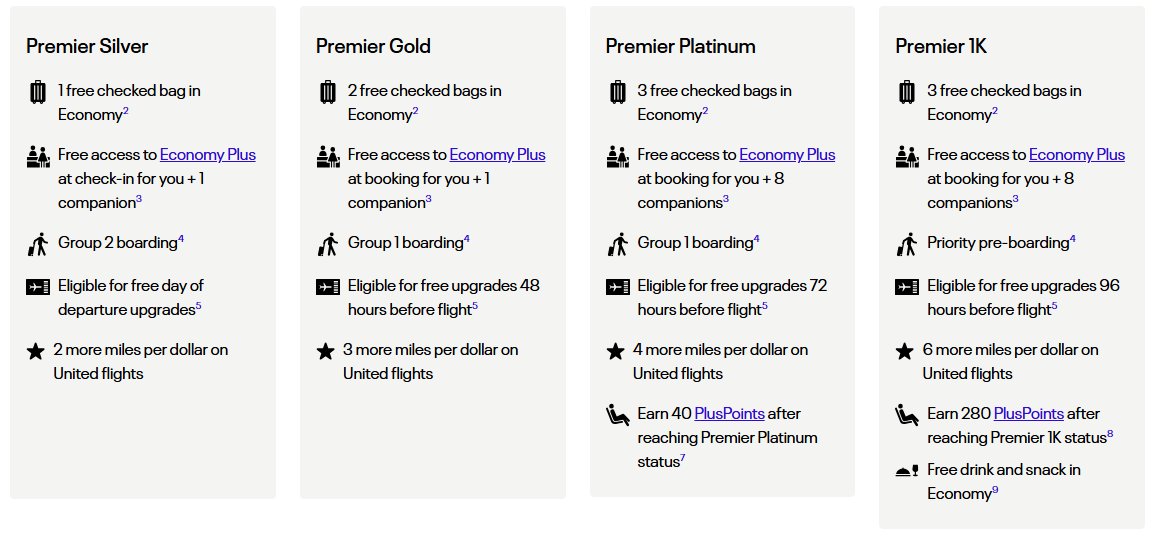
Here's how each tier stacks up in practice:
A few things the table doesn't fully convey. The upgrade window is one of the most tangible status benefits for frequent United flyers — Platinum members are eligible for complimentary upgrades 72 hours before departure, while 1K members get 96 hours. That head start matters on competitive routes where upgrade inventory fills quickly. PlusPoints — awarded at Platinum (40) and 1K (280) — can be used to confirm upgrades to Polaris business class on United-operated flights, and as of February 2026, can now be applied to award tickets as well.
The honest assessment for most readers: status is worth pursuing only if you're already flying United frequently enough to reach it naturally. If you're routing your travel through United specifically to chase status you wouldn't otherwise earn, the tradeoff is probably not worth it compared to building Chase Ultimate Rewards transferable balances from a wider range of cards and using them strategically.
The exception: United hub cities. If you live near Newark, Chicago O'Hare, Denver, Houston, San Francisco, Los Angeles, or Washington Dulles — and United dominates your departure airport's route network — status changes the math considerably. Complimentary domestic upgrades, Economy Plus access, and lounge access on international itineraries deliver consistent, tangible value for frequent hub travelers that no amount of strategic award redemption can replicate.
What to Avoid
Everyday awards. If Saver pricing isn't available and the only option is Everyday pricing, the default answer should be to not redeem miles for that flight. Everyday awards cost significantly more miles for the same route, driving per-mile value below the program average. Either find a different date with Saver availability, check a partner program, or pay cash.
Non-flight redemptions. United offers miles for hotel stays, car rentals, United Club memberships, TSA PreCheck fees, and merchandise. The effective value on all of these is around 1 cent per mile or below — well beneath what you'd get on a Saver award flight. United's own Money + Miles product gives you a fixed 1 cent per mile for cash-off purchases, which the program itself acknowledges is below the Saver award value. Keep miles for flights.
Speculative transfers from Chase. This is the most expensive mistake in the MileagePlus ecosystem. Chase points are worth 2+ cents each by most independent estimates. Transferring to United at 1:1 when no specific redemption is confirmed converts your highest-value currency into a lower-value one with no ability to reverse it. The one exception: if United is running a rare transfer bonus from Chase (historically uncommon, unlike Amex's more frequent airline bonuses), and you have a specific award in mind, the math can favor the transfer.
Booking partner awards at partner premium pricing when a better option exists. If Air Canada Aeroplan prices the same Lufthansa seat 10,000 miles cheaper than United does, and you hold Chase points that transfer to both at 1:1, book through Aeroplan. The programs aren't in competition from your perspective — the goal is always the best per-mile value for the specific award.
Ignoring the 18-month expiration. Unlike Delta SkyMiles, which never expire, MileagePlus miles disappear after 18 months of inactivity. A shopping portal purchase, a dining partner transaction, or a single flight credit resets the clock. Set a reminder if your account will go dormant — losing a built-up balance to inactivity is an entirely avoidable mistake.
The Final Edit
United MileagePlus is a better program than its reputation suggests — and a more complex one than its marketing implies. The name anchors it to United Airlines, but the actual product is access to 26 Star Alliance carriers, several of the best premium cabin products in commercial aviation, and one of the most useful programs in the Chase ecosystem for travelers who want to use their points for international business class.
The clearest case for building MileagePlus miles: you hold a Chase Sapphire Reserve or Preferred, you want to fly premium cabin internationally, and the routes you're targeting run through Lufthansa, SWISS, ANA, or United's own Polaris product. In that scenario, MileagePlus Saver awards deliver some of the best per-mile value available from Chase's transfer partner list — 2 cents per mile on transatlantic business class, 2-plus cents on ANA to Japan. That's a strong return on a currency most people think of as an everyday cash-back substitute.
The case against centering your entire strategy on MileagePlus: the transfer partner list is narrow, Saver availability requires patience and flexibility, and other Star Alliance programs (Aeroplan, LifeMiles, ANA) often price the same seats cheaper. MileagePlus is most powerful as one tool in a broader toolkit — not as the single repository for all your Chase or Bilt points.
The program doesn't need to be your only option to be worth using. It needs to be the best option for the specific trip you're planning. When it is — and for transatlantic Polaris or ANA to Tokyo, it frequently is — there's nothing underrated about it.
Card benefits, fees, and offers are subject to change — always verify current terms directly with the issuer before applying. The Global Edit may earn a commission if you apply for a card or book through links on this site. This does not influence our recommendations or editorial verdict.
Editorial Disclosure: This article was written with the assistance of artificial intelligence and reflects the author's honest research, experience, and editorial judgment. AI-assisted content on The Global Edit is always reviewed, edited, and approved by our editorial team before publication.