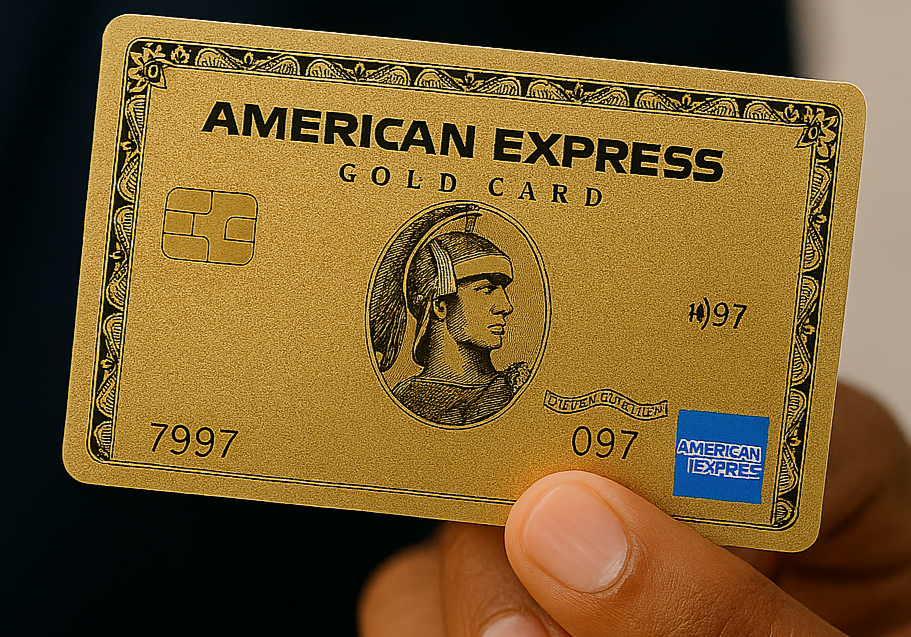
The Amex Platinum gets the headlines. The Amex Gold gets the results.
At $325 a year, the American Express Gold Card is built around a simple premise: if you eat at restaurants, shop at grocery stores, and use Uber, the credits and points stack will more than cover the fee. In 2026, the math is hard to argue with — the card delivers $424 in annual statement credits alone, before a single Membership Rewards point is earned or redeemed.
That said, the Gold has a real limitation that doesn't get enough attention: it's a food-first card. It doesn't have lounge access, it doesn't carry hotel elite status, and its travel protections are solid but not exceptional. Know what you're buying and it's one of the best-value mid-tier cards available. Go in expecting a Platinum Lite and you'll be disappointed.
Here's the complete breakdown.
Annual fee: $325 · Additional cardholders: Free (up to 5) · Best earning rate: 4x at restaurants worldwide and U.S. supermarkets · Total annual credits: Up to $424 · Enrollment required for most credits — do this in your first week.
What the Amex Gold Actually Is
The Amex Gold sits in the middle of American Express's personal card lineup — above the no-fee Blue Cash Everyday, below the $895 Platinum. It earns the same Membership Rewards points as the Platinum, which means those points transfer to the same 19+ airline and hotel partners, including Air Canada Aeroplan, British Airways Avios, Delta SkyMiles, Singapore Airlines KrisFlyer, and Marriott Bonvoy.
The card's design philosophy is focused: earn as many points as possible on the two things most people spend the most money on — food and groceries — and offset the annual fee with targeted statement credits in the same categories. It executes that strategy well.
What it isn't: a comprehensive travel card. If airport lounge access is your priority, you need the Amex Platinum or the Chase Sapphire Reserve.
The Credits — Do They Cover the Fee?
The short answer is yes, if you're intentional about using them. Here's the full picture:
| Credit | Annual Value | Structure |
|---|---|---|
| Dining Credit (Grubhub, Cheesecake Factory, Buffalo Wild Wings, Five Guys, Wonder) | $120 | $10/month |
| Uber Cash | $120 | $10/month |
| Resy Dining Credit | $100 | $50 semi-annually |
| Dunkin' Credit | $84 | $7/month |
| Total credits | $424 | — |
Against a $325 fee, that's a theoretical $99 positive before earning a single point. In practice, value depends on which credits fit your actual life.
Dining Credit — $120/year
Up to $10 per month as a statement credit when you pay with the Gold at Grubhub (including Seamless), Buffalo Wild Wings, Five Guys, The Cheesecake Factory, and Wonder. The credit doesn't roll over — unused amounts expire at the end of each month.
The limitation here is the partner list. This is a deliberate, narrow set of restaurants, not a broad dining credit. If you order from Grubhub or eat at any of those chains at least once a month, it's automatic value. If none of them fit your habits, you'll leave some of it unused.
Grubhub is the most flexible option in the dining credit — it covers tens of thousands of restaurants for delivery and pickup. If you already order delivery, this is the easiest $120/year you'll ever capture.
Uber Cash — $120/year
$10 per month deposited into your Uber account for rides or Uber Eats orders in the U.S. You need to add the Gold Card to your Uber account and select it as the payment method. Like the dining credit, this doesn't roll over month to month.
If you use Uber or DoorDash at all — or if you already have the Amex Platinum and are stacking credits — this is effortless. The Gold and Platinum Uber credits can be combined in the same Uber account, giving you $20/month total from both cards.
Resy Dining Credit — $100/year
Up to $50 in the first half of the year, $50 in the second half, as a statement credit at qualifying U.S. Resy restaurants. Resy covers a wide range of quality restaurants in major cities — this is a more flexible dining credit than the Grubhub-specific one above, and in a market with good Resy coverage it's close to automatic.
The semi-annual structure means you can't bank the full $100 for one big dinner at the end of the year. Use $50 by June 30, then another $50 by December 31.
Dunkin' Credit — $84/year
Up to $7 per month at U.S. Dunkin' locations. Honest assessment: this is the most niche credit on the card. If you drink coffee and there's a Dunkin' nearby, it's an extra $84/year for something you were already buying. If you don't, it does nothing.
One workaround: load the credit monthly into the Dunkin' app as app balance, which lets you accumulate it for a larger purchase or a gift. It's a small win but a real one.
Four of the five credits on this card reset monthly and don't roll over. That's a management overhead that some people handle easily and others consistently forget. If you're the type to set a calendar reminder on the 25th of each month, the Gold rewards you well. If you're not, you'll lose a meaningful chunk of the value you're paying for.
Earning Rates — Where This Card Shines
This is the genuine headline for the Amex Gold. The earning structure:
- 4x points at restaurants worldwide (up to $50,000/year, then 1x)
- 4x points at U.S. supermarkets (up to $25,000/year, then 1x)
- 3x points on flights booked directly with airlines or through AmexTravel.com
- 5x points on prepaid hotels booked through AmexTravel.com (updated April 2026)
- 1x points on everything else
The 4x rate on dining and groceries is one of the best available on any card in those categories. Put your restaurant spending and grocery bill on this card and you're accumulating Membership Rewards points at a rate that adds up fast.
A household spending $1,500/month combined on restaurants and groceries earns roughly 72,000 Membership Rewards points per year from those categories alone — worth approximately $1,440 at 2 cents per point when transferred to a premium airline partner. That's more than four times the annual fee before credits.
"The Gold is the card you reach for every single day. The Platinum is the card you carry for the trip."
The 3x on flights is solid for a mid-tier card. It's weaker than the Platinum's 5x on flights, but if you don't want to pay the Platinum's fee, 3x here is a fair consolation.
The Hotel Collection
The Gold doesn't have Fine Hotels + Resorts access — that's Platinum territory. What it does have is The Hotel Collection: book a minimum two-night stay at over 1,300 eligible properties through AmexTravel.com and receive a $100 credit toward eligible on-property charges, plus room upgrades, noon check-in, and late checkout when available.
The $100 property credit is real money toward dining, spa, or resort fees. Combined with the 5x earning rate on the booking itself, a two-night stay through The Hotel Collection adds meaningful value — particularly for shorter getaways where the math on Fine Hotels + Resorts may not justify a Platinum card.
The trade-off: booking through Amex Travel means you generally won't earn hotel loyalty points or status credit for the stay. For Gold cardholders without hotel elite status (the Gold doesn't come with any), this is less of a sacrifice than it would be for a Marriott Titanium or Hilton Diamond member.
Membership Rewards and Transfer Partners
Membership Rewards points from the Gold transfer to the same partner network as the Platinum — which is the program's strongest feature. Key transfer partners include:
- Air Canada Aeroplan — consistently the best-value redemption for Star Alliance flights, including United and Lufthansa metal
- British Airways Avios — excellent for short-haul redemptions and Iberia/Qatar flights
- ANA Mileage Club — one of the best partners for premium cabin redemptions to Asia and beyond
- Delta SkyMiles — useful but variable; transfer only when there's a specific redemption in mind
- Flying Blue (Air France/KLM) — strong for transatlantic business class
- Singapore Airlines KrisFlyer — premium redemptions on Singapore Airlines and partners
- Marriott Bonvoy — generally a poor use of points; transfer at 1:1.2 ratio (60,000 MR → 75,000 Bonvoy)
The standard advice applies: never transfer to a hotel program unless for a specific booking. Airline partners deliver consistently better value, typically 1.5–2+ cents per point when used for premium cabin international flights.
At 1 cent per point through Amex Travel for flights, the Gold's floor redemption value is straightforward. The ceiling — via Aeroplan or ANA for business class — can push well past 2 cents per point.
What the Gold Card Does Not Have
This is worth stating directly, because the Gold is sometimes positioned as a near-Platinum card at a lower price. It isn't.
No lounge access. The Gold has no Centurion Lounge access, no Priority Pass, no Delta Sky Club. If you want airport lounges, the Amex Platinum or Chase Sapphire Reserve are the right cards.
No hotel elite status. The Platinum comes with complimentary Hilton Gold and Marriott Gold. The Gold card comes with neither.
No travel credit. The Chase Sapphire Reserve's $300 broad travel credit is one of the most flexible in the industry. The Gold's credits are food-specific and structured around monthly resets.
Lower travel protections. Trip delay and cancellation coverage exists, but the per-claim limits and conditions are less generous than the Platinum's.
None of this is a reason not to carry the Gold — it's just context. Know what you're getting and the card is excellent. Expect lounge access or status perks at $325 and you'll be disappointed.
Amex Gold vs. Amex Platinum — Which One to Get
The most common question, and it has a clean answer.
Get the Amex Gold if:
- Dining and grocery spending is your highest category
- You don't fly frequently enough to justify lounge access
- You want Membership Rewards points without the Platinum's fee
- You'll actually use the monthly food credits
Get the Amex Platinum if:
- You fly through Centurion Lounge airports 6+ times per year
- You want hotel elite status (Hilton Gold, Marriott Gold)
- You'll use the $600 hotel credit and the broader lifestyle credits
- The $895 fee doesn't require you to contort your spending to justify it
Carry both if:
- You want 4x on dining and groceries (Gold) plus lounge access and 5x on flights (Platinum)
- You can stack Uber credits — $10/month from each card, $240/year combined
The two-card Amex setup is one of the most popular configurations in the points world for a reason. The Gold earns on your daily spend; the Platinum pays for itself on travel.
Who Should Carry the Amex Gold
Strong fit:
- People who spend $800+ per month combined on restaurants and groceries
- Anyone who uses Uber or orders delivery regularly
- City dwellers with strong Grubhub and Resy restaurant coverage
- People who want to earn Membership Rewards without the Platinum's fee
- Frequent travelers who already have a lounge card and just need a strong everyday earner
Poor fit:
- Travelers who prioritize lounge access above everything else
- People who rarely eat at restaurants or order delivery
- Anyone outside major cities with limited Resy and Grubhub coverage
- Someone looking for a single card that does everything
The Final Edit
The Amex Gold is the most straightforward value proposition in Amex's lineup. Against a $325 annual fee, it puts $424 in annual credits on the table before you factor in the earning rate. For anyone who eats out regularly and uses Uber, this card pays for itself without any optimization gymnastics.
The caveat is real: this is a food card, not a travel card. It won't get you into the Centurion Lounge. It won't give you Marriott status. If that's what you need, the math points toward the Platinum or a Chase card instead.
Our verdict: if your Grubhub, Uber, and restaurant spending is already part of your regular life, the Gold is essentially free — and the 4x earning rate on top of that makes it one of the best points-generating tools for daily spending available. Start here before the Platinum. Understand the credits, build the habit, earn the points — then decide whether the upgrade to $895 makes sense when your travel patterns warrant it.
If you're already running the Chase Sapphire Reserve and want a complementary everyday earner on a different points currency, the Gold pairs exceptionally well.
Card benefits, fees, and offers are subject to change — always verify current terms directly with American Express before applying. The Global Edit may earn a commission if you apply for a card through links on this site. This does not influence our recommendations or editorial verdict.
Editorial Disclosure: This article was written with the assistance of artificial intelligence and reflects the author's honest research, experience, and editorial judgment. AI-assisted content on The Global Edit is always reviewed, edited, and approved by our editorial team before publication.