Every premium travel card on the market eventually asks you to do homework. Track which quarter has the 5x bonus category. Remember whether this purchase qualifies for the dining credit or the entertainment credit or the streaming credit. Activate the offer before the statement closes or lose it.
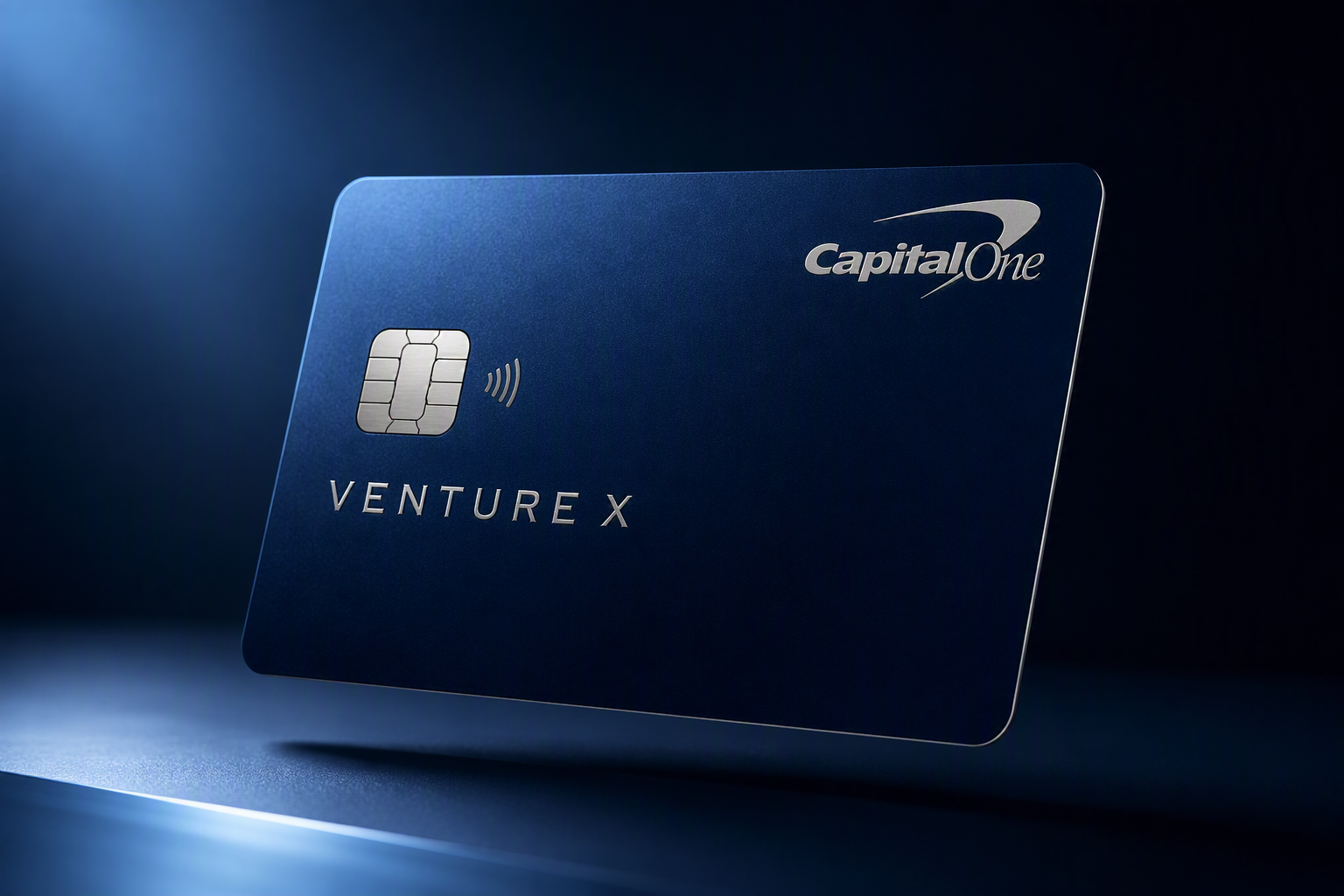
The Capital One Venture X doesn't ask any of that. It earns 2 miles per dollar on every purchase, with no categories to track and no offers to activate. That single design decision is the entire personality of the card — and it's exactly why it's become the quiet favorite of travelers who got tired of managing five different premium cards just to capture the bonus categories on each one.
This site has covered Chase, Amex, and Citi premium cards extensively. The Venture X has been a real gap. Here's the honest case for it — what it does well, what changed for the worse in 2026, and where it actually fits next to the cards already in your wallet.
What the Venture X Actually Is
The Venture X is Capital One's flagship premium travel card, carrying a $395 annual fee — meaningfully lower than the Chase Sapphire Reserve's $795 or the Amex Platinum's $895. It launched in November 2021 and has kept its fee unchanged for nearly five years while competitors have raised theirs repeatedly.
Annual fee: $395
Welcome bonus: 75,000 miles after $4,000 spend in 90 days
Base earning: 2x miles on every purchase, no categories
Annual travel credit: $300 (Capital One Travel bookings only)
Anniversary bonus: 10,000 miles every year starting year two
Foreign transaction fees: None
Network: Visa Infinite
The card's appeal has always rested on simplicity. There's no spreadsheet required to maximize it. You use it for everything, it earns at the same rate regardless of category, and the handful of credits that exist are straightforward rather than buried in fine print.
The Annual Fee Math
This is where the Venture X earns its reputation as one of the easiest premium cards to justify.
The $300 travel credit and the $100-value anniversary miles alone get you to $400 — more than the entire annual fee — before you've used the card for a single purchase or stepped into a single lounge. The catch, and it's a real one: the $300 credit only applies to bookings made through the Capital One Travel portal. If you'd rather book directly with an airline or hotel for status-qualifying reasons, you're leaving that credit on the table unless you can route a flexible booking through the portal.
Two smaller lifestyle perks round out the package: a complimentary PRIOR subscription (Capital One values it at $149) covering destination guides and travel content, and a discounted Cultivist membership giving 50% off access to more than 60 of the world's best museums for up to two years. Neither is the reason to get the card, but they're real value that comes free with the fee.
For a traveler who books even one flight or hotel stay per year through Capital One Travel, the fee math works out cleanly. That's a meaningfully lower bar than competitors that require activating specific statement credits across a dozen categories to hit positive value.
Lounge Access - What Changed in 2026
This is the section that needs an honest update, because the Venture X's lounge benefit looked different a year ago.
"As of February 1, 2026, Venture X guests cost extra — unless you've spent $75,000 on the card in a calendar year. That's a real downgrade from the unlimited-guest era."
Venture X cardholders get complimentary access to Capital One Lounges (Dallas-Fort Worth, Denver, Washington Dulles, Las Vegas, JFK, and the new LaGuardia Capital One Landing that opened February 2026) plus Priority Pass Select membership covering more than 1,300 lounges worldwide.
Through January 2026, primary cardholders could bring unlimited guests into Capital One Lounges for free. That changed on February 1, 2026. Now:
- Capital One Lounges: Guests cost $45 per adult, $25 per child (ages 2–17), per visit — unless you've spent $75,000 on the card in a calendar year, which restores complimentary guest access.
- Priority Pass lounges: No complimentary guest access at any spending level. Guests cost $35 each per visit, every time.
- Authorized users: Get their own complimentary lounge access if added to the account, but adding one costs a $125 annual fee per authorized user.
Adding an authorized user ($125/year) gets them their own complimentary access to Capital One Lounges, but it does not fully solve the Priority Pass problem — cardholder reviews report that even authorized users with their own Priority Pass enrollment can still face per-visit charges at Priority Pass lounges specifically. If your travel is mostly through airports with a Capital One Lounge (Dallas-Fort Worth, Denver, Dulles, Las Vegas, JFK, or the new LaGuardia Landing), the authorized user route pays off. If you're relying mainly on Priority Pass's broader network, confirm the current guest and authorized-user terms directly with Capital One before assuming the fee is solved.
This is a real downgrade from the card's original value proposition, and it's worth factoring into the decision honestly rather than repeating outdated "unlimited free guests" claims that circulate online. The lounges themselves remain genuinely excellent — Capital One has invested heavily in design and food quality — but solo travelers now get more relative value from the benefit than families or couples do, unless that $75,000 spend threshold is realistic for your situation.
Earning Structure
The Venture X's earning rates are deliberately simple, with one important nuance most cardholders miss.
The flat 2x on absolutely everything — groceries, gas, streaming, restaurants, utility bills — is the card's quiet strength. No quarterly activation, no 1.5% default rate that other cards fall back to outside bonus categories. It's a true do-nothing-and-still-earn-well card, which is precisely the appeal for readers who don't want to juggle five cards across five spending categories.
The 10x and 5x bonus rates only apply to bookings made directly through the Capital One Travel portal — meaning your day-to-day flight and hotel purchases, booked directly with the airline or hotel, earn the same flat 2x as a grocery run. This is the single biggest structural difference from Chase and Amex, where premium cards typically award elevated multipliers on travel purchases regardless of where you book.
The card also runs on Visa Infinite, which includes primary rental car coverage (meaning you can decline the rental company's collision coverage entirely, rather than relying on secondary coverage that only kicks in after your personal auto insurance) and trip delay reimbursement of up to $500 per ticket when a covered delay exceeds six hours or requires an overnight stay.
Transfer Partners - Where the Real Value Lives
This is the section that separates Venture X miles from a simple cash-back card, and it's where the card's real ceiling lives.
Capital One miles transfer to over 15 airline and 3 hotel programs, the large majority at a 1:1 ratio. Critically — and this is the gap competitors don't have — Capital One transfers to Turkish Airlines Miles&Smiles and TAP Air Portugal, programs that neither Chase nor Amex can reach.
The Turkish Hawaii sweet spot is the program's most famous trick. Turkish prices Hawaii as part of its domestic US pricing chart, so a one-way economy flight from the mainland to Hawaii on United (a Star Alliance partner) runs just 7,500 Turkish miles — versus the 25,000+ United would normally charge through its own program. This is a genuinely excellent use of Venture X miles for anyone planning a Hawaii trip who doesn't already hold Hyatt or Hawaiian-specific currency.
Avianca LifeMiles is the most underrated partner on this list. It offers reasonable Star Alliance award pricing and — unlike many programs — doesn't pass along fuel surcharges on partner awards, which keeps the all-in cost of a business class redemption to United or Lufthansa partners genuinely low.
Flying Blue's Promo Rewards make the program worth checking monthly. Outside of flash sale periods, Flying Blue's dynamic pricing can be unpredictable, but during a Promo Rewards window, the same Europe business class redemption can drop by 25–50%.
What the Venture X notably lacks: any major US domestic airline partner. No Delta, no United, no American, no Southwest. If your travel is primarily domestic on one of the big four US carriers, the Venture X's transfer ecosystem won't directly help — you'd be using the card for its flat 2x earning and redeeming through the Capital One Travel portal at 1 cent per mile instead. For US domestic-focused readers, our guides to Delta SkyMiles, United MileagePlus, and American AAdvantage cover those ecosystems directly.
The honest transfer guidance applies here as everywhere: never transfer speculatively. Confirm the award is bookable at the partner program before you move a single mile. Capital One transfers are typically instant, which removes some of the risk other programs carry, but partner award space can still disappear in the time it takes to complete the transfer.
Venture X vs. Chase Sapphire Reserve vs. Amex Platinum
The honest positioning: the Sapphire Reserve wins on transfer partner quality (Hyatt at 1:1 remains the best hotel transfer in the industry) and built-in hotel elite status. The Amex Platinum wins on the sheer breadth of lounge networks (Centurion, Priority Pass, Delta Sky Club access with a Delta flight) but demands the most homework to extract full value from its dense menu of category-specific credits. The Venture X wins on simplicity and fee efficiency — nobody has to think hard about whether they're "using it right."
For a TGE reader who already holds a CSR or Amex Platinum: the Venture X isn't a replacement, it's a complement. It's the card you put your everyday non-bonused spending on, since 2x flat beats the 1x default rate most other premium cards fall back to outside their bonus categories. Pair it with a Citi Strata Premier or Chase Sapphire for category coverage, and the Venture X becomes the card that catches everything else. Our Amex Platinum vs. Chase Sapphire Reserve comparison covers how those two stack up directly if you're deciding between just those.
Who Should Get This Card
Get it if: you want one card that earns well on every purchase without tracking categories, you book at least one trip a year through a flexible portal, you're comfortable with Visa Infinite's transfer partner mix (strong on Star Alliance and SkyTeam, weak on US domestic carriers), and you'd rather not manage a dense menu of niche statement credits.
Skip it if: your travel is heavily concentrated on one of the big four US airlines and you'd rather build status and miles directly with that carrier, you travel as a family or couple and the new lounge guest fees would add up fast, or you already hold a Sapphire Reserve and Amex Platinum and don't need a third premium card competing for the same wallet space.
Consider the entry-level Venture card instead if: you want the simplicity of flat-rate earning without the $395 fee. The standard Venture Rewards card charges just $95 annually and still earns 2x on everything, though it skips the lounge access and most of the premium credits.
The Final Edit
The Venture X earned its reputation by doing something genuinely rare in the premium card space: it made the math simple. No quarterly category tracking, no fifteen-line credit menu to half-remember, just 2x on everything and a $395 fee that two recurring credits nearly cover before you've spent a dollar elsewhere.
The 2026 lounge changes are a real asterisk, and any honest review has to say so plainly — solo travelers still get excellent value, but couples and families now pay for what used to be free. That doesn't sink the card. It just means the Venture X earns its keep through simplicity and transfer flexibility rather than through unlimited guest access anymore.
If you're choosing your first premium travel card and don't want a second job tracking it, start here. If you already have a CSR or Platinum in your wallet, the Venture X is the clean addition that catches every dollar those cards don't bonus.
Card benefits, fees, and offers are subject to change — always verify current terms directly with the issuer before applying. The Global Edit may earn a commission if you apply for a card or book through links on this site. This does not influence our recommendations or editorial verdict.
Editorial Disclosure: This article was written with the assistance of artificial intelligence and reflects the author's honest research, experience, and editorial judgment. AI-assisted content on The Global Edit is always reviewed, edited, and approved by our editorial team before publication.