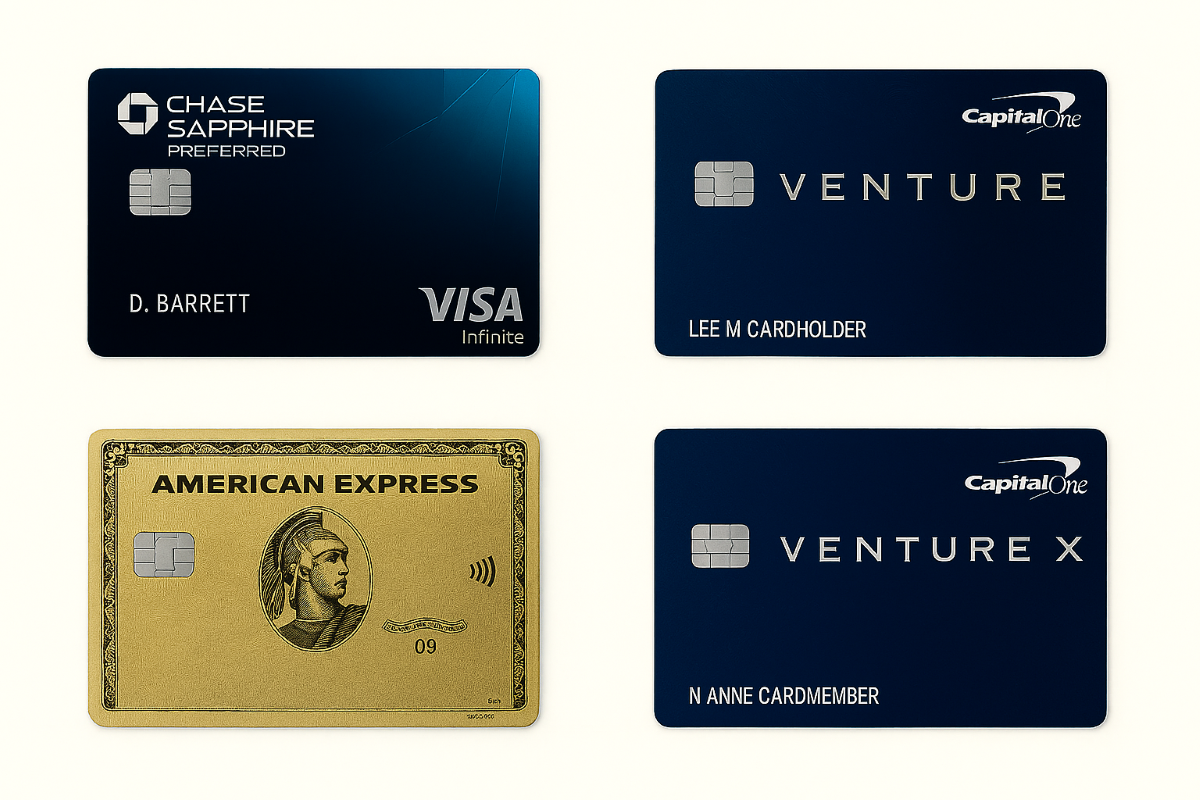
The first travel credit card is the most important one you'll ever pick. Not because it'll be the best card in your wallet forever — it won't — but because it determines whether you start the game with the right foundation or spend two years locked out of the best sign-up bonuses by a mistake made when you didn't know the rules.
This guide is for people who are serious about travel rewards but haven't carried a dedicated travel card yet, or who picked one early without understanding what they were doing. We'll cover the four best starter cards in 2026, what each one is genuinely good for, and — just as importantly — the mistakes that cost beginners real money before they've earned a single free night.
One thing upfront: card details, fees, and welcome bonuses change. All figures in this article reflect verified terms as of June 2026. Always confirm current offers directly with the card issuer before applying.
Before You Pick a Card, Understand the Game
Travel rewards cards work on a simple premise: you spend money you were going to spend anyway, earn points or miles, and redeem those for travel worth more than the cash you put in. Done well, it's one of the highest-return financial habits available to someone who travels regularly.
But the system has rules — and beginners who don't know them end up wasting signup bonuses worth hundreds of dollars, applying in the wrong order, or carrying the wrong card for their spending patterns.
Three things to understand before applying for anything:
Chase's 5/24 rule is the most important rule in the game. Chase will automatically deny your application for most of their cards if you've opened five or more credit cards — across any bank — in the last 24 months. This means if you go on an application spree starting with other banks, you may lock yourself out of the best beginner card on the market for two years. Apply for Chase cards early, before you do anything else.
You can only hold one Chase Sapphire card at a time. You cannot simultaneously hold both the Chase Sapphire Preferred and Chase Sapphire Reserve. If you have one and want to upgrade to the other, you product-change rather than reapply.
The 48-month bonus rule. Most major issuers won't let you earn a welcome bonus on the same card more than once every 48 months. This affects Chase, Amex, and Capital One. Plan accordingly — you don't want to apply for a card you've already collected the bonus on.
If the Chase Sapphire Preferred is on your list — and it should be — apply for it before any other card. Chase's 5/24 rule means every non-Chase card you open first is a strike against you. Get the Chase card first, then build out the rest of your wallet.
How to Read a Welcome Bonus
Every travel card leads with a welcome bonus: earn X points after spending Y dollars in the first Z months. These bonuses are how most beginners get their first big points haul — and they're often worth more than a full year of everyday spending.
Here's how to evaluate one honestly:
The spending requirement matters as much as the bonus. A 75,000-point bonus that requires $5,000 in three months is meaningfully different from one requiring $4,000. For someone spending $1,500–2,000 per month organically, hitting $4,000 in three months is achievable. Hitting $5,000 may require timing a big expense — a car insurance payment, a flight booking, a utility prepay — to cross the line.
Don't manufacture spend you wouldn't otherwise have. Buying things you don't need to hit a spending requirement is not a deal. It's paying retail prices for points. Time your application around a natural large purchase — a vacation booking, a home repair, an annual subscription — and let organic spending carry most of the weight.
Know what the points are actually worth. Points redeemed through a card's own travel portal typically carry a fixed value (1.25 cents for CSP, 1.5 cents for CSR). Transferred to airline and hotel partners, they can be worth significantly more — or less, depending on the redemption. A 75,000-point bonus worth $937 through a portal may be worth $1,500+ transferred to the right partner.
The Best Starter Card: Chase Sapphire Preferred
Annual fee: $95 | Welcome bonus: 75,000 points after $5,000 in 3 months | Portal value: 1.25¢/point
The Chase Sapphire Preferred is the most recommended beginner travel card on the market — and not because the industry is wrong about this. It genuinely is the best starting point for most people, for three reasons that compound over time.
First, it gives you access to Chase Ultimate Rewards transfer partners at a low cost. Chase Ultimate Rewards is the most flexible points currency in travel. With the Preferred, your points transfer to United MileagePlus, Southwest Rapid Rewards, Air Canada Aeroplan, British Airways Avios, Air France/KLM Flying Blue, Singapore Airlines KrisFlyer, IHG One Rewards, World of Hyatt, and Marriott Bonvoy — among others, most at 1:1.
As of June 15, 2026, new Chase Sapphire Preferred applicants transfer Ultimate Rewards to World of Hyatt at a 4:3 ratio rather than 1:1 — 40,000 Chase points becomes 30,000 Hyatt points. This is a Preferred-specific change; the Chase Sapphire Reserve retains the 1:1 ratio. Hyatt remains a strong transfer partner from the Preferred — but if Hyatt redemptions are central to your strategy, this is a point in the Reserve's favor. See our full breakdown of the 2026 transfer change for details.
Second, it earns well across the categories that matter most for everyday spenders. The Preferred earns 5x on travel booked through Chase Travel, 3x on dining, 3x on select streaming services, 3x on online grocery purchases (excluding Target, Walmart, and wholesale clubs), and 2x on all other travel. For most people, dining and groceries are two of their largest monthly spending categories. The Preferred turns both into premium travel currency.
Third, it's forgiving. The $95 fee is low enough that you don't need to be a card optimizer to come out ahead. The $50 annual hotel credit for Chase Travel bookings knocks the effective fee to $45. The 10% anniversary points bonus — you receive bonus points equal to 10% of all purchases made the previous year — adds quiet value on top of your everyday earning. A cardholder spending $20,000 per year gets 2,000 bonus points at renewal just for keeping the card open.
The 75,000-point welcome bonus is worth $937 through Chase Travel at 1.25 cents per point — nearly ten years of annual fees in one shot. Transferred to Hyatt at the new 4:3 ratio, those 75,000 points become 56,250 Hyatt points — still enough to cover one to two nights at a mid-tier Hyatt property depending on the season. For a first card, that's still an exceptional starting position, even if the Hyatt math isn't quite what it used to be.
The Preferred also comes with solid travel protections: primary rental car insurance (no need to buy the rental company's collision waiver), trip cancellation and interruption insurance up to $10,000 per person, trip delay reimbursement after 12 hours, and baggage delay coverage. These aren't exciting benefits until you need them — and when you do, they're worth substantially more than the annual fee.
Who the Chase Sapphire Preferred is for: Almost everyone starting out. If you travel at least a couple of times per year, eat at restaurants, and want broad access to Chase's transfer partner network, this is the right first card. Hyatt remains one of the strongest hotel programs to transfer into, even at the new 4:3 ratio — it's just no longer the slam-dunk 1:1 it once was for Preferred holders. The path from here — holding the Preferred for a year or two, then product-changing or upgrading to the Chase Sapphire Reserve when the math justifies it — is the most well-worn road in the beginner-to-advanced travel card journey, and it's also how you'd regain the 1:1 Hyatt ratio.
Who should skip it: Someone whose primary spending is at physical grocery stores (Amex Gold's 4x beats the Preferred there) or who spends heavily on flights and wants a higher earning rate. It's also not the right card if you've already hit 5/24 — you'll be denied regardless.
The Preferred gets dramatically more powerful when paired with a Chase Freedom Unlimited (1.5x on everything, no annual fee) and a Chase Freedom Flex (5x on rotating quarterly categories). All points earned across those cards pool together and can be redeemed at the Preferred's 1.25¢ portal rate or transferred to partners. This combination gives you best-in-category earning rates across almost every spending type — no other bank has a comparable no-fee companion ecosystem.
Best for Foodies and Groceries: Amex Gold
Annual fee: $325 | Welcome bonus: Up to 100,000 points after $8,000 in 6 months | Credits: Up to $424/year
The Amex Gold is not a beginner card in the traditional sense — the $325 fee requires more active management than the Preferred's $95. But for the right person, it's the most natural starting card available: someone who spends heavily on restaurants and groceries and wants those everyday purchases earning premium travel points.
The earning rates are the headline. The Gold earns 4x at restaurants worldwide, 4x at U.S. supermarkets (up to $25,000/year), 3x on flights booked directly or through Amex Travel, 5x on prepaid hotels booked through AmexTravel.com, and 1x on everything else. For a household spending $1,500 per month combined on dining and groceries, that's roughly 72,000 Membership Rewards points per year from those two categories alone — before a single travel purchase.
The credit stack theoretically offsets the fee entirely: up to $120 in monthly dining credits (Grubhub, Buffalo Wild Wings, The Cheesecake Factory, Five Guys, and Wonder — $10/month), $120 in Uber Cash ($10/month added to your Uber account), $100 in Resy dining credits ($50 semi-annually at qualifying restaurants), and $84 in Dunkin' credits ($7/month). That's $424 in stated annual value against a $325 fee.
The honest caveat: most of these credits are narrow and reset monthly without rollover. The dining credit applies to a specific list of restaurants. The Resy credit requires qualifying restaurants. The Dunkin' credit is only useful if there's a Dunkin' near you. The Gold rewards disciplined credit users — if you'll manage four separate monthly credits without letting them expire, the math is compelling. If you won't, the effective fee is closer to the stated $325.
The Amex Gold earns Membership Rewards points, which transfer to the same 19+ airline and hotel partners as the Platinum — though notably, Membership Rewards does not transfer to Hyatt. For hotel-focused point redemptions, Chase Ultimate Rewards (via the Sapphire Preferred) has the edge.
Who the Amex Gold is for: Someone who spends $500 or more per month on dining and groceries combined and will realistically manage the monthly credits. Also a strong companion to the Amex Platinum for cardholders who want to maximize Membership Rewards earning across both everyday and travel spending. Our full Amex Gold review covers the complete credit and earning breakdown in detail.
Who should skip it: Anyone who doesn't eat out or shop at U.S. supermarkets frequently — the card's earning advantage disappears outside those categories. Also not ideal if you want lounge access or hotel transfer partner depth; that's the Platinum and the Sapphire family respectively.
Best for Simplicity: Capital One Venture
Annual fee: $95 | Welcome bonus: 75,000 miles after $4,000 in 3 months | Earn rate: 2x on everything
The Capital One Venture is the most beginner-friendly card on this list — not because it's the most powerful, but because it's the most forgiving. You earn 2x miles on every purchase, no categories to track, no portals to book through, no multiplier gymnastics. Put the card in your wallet, spend normally, and earn travel currency at a consistent rate.
The Venture earns 5x miles on hotels, vacation rentals, and rental cars booked through Capital One Travel, and 2x on everything else. Those miles are worth 1 cent each when redeemed to cover travel purchases on your statement — effectively 2% back on all spending toward travel. The more interesting play is transferring to Capital One's 15+ airline and hotel partners, where the right redemption can push value to 1.5–2 cents per mile.
Transfer partners include Air Canada Aeroplan, Turkish Airlines Miles & Smiles, Avianca LifeMiles, British Airways Avios, Flying Blue, and Wyndham Rewards. It's a solid but narrower roster than Chase Ultimate Rewards — no Hyatt, no United, no Southwest.
The $95 fee is identical to the Sapphire Preferred. The key difference: the Preferred's earning structure rewards deliberate spenders who put the right purchases on the right card, while the Venture rewards people who want one card to handle everything simply. The Preferred's transfer partner lineup is stronger. The Venture's flat 2x is easier to maximize without thinking about it.
"The Capital One Venture is the best card for someone who wants to start earning travel miles without changing how they spend — 2x on everything, no categories, no management overhead."
Who the Capital One Venture is for: Beginners who want a simple introduction to travel rewards without category management. Also a strong option as a companion card for anything that doesn't hit a bonus category on your other cards. If most of your spending falls outside the dining/travel/grocery categories that premium cards reward, the Venture's flat 2x often outperforms the 1x base rate on everything else.
Who should skip it: Anyone ready to engage with transfer partners and category optimization — the Sapphire Preferred's ecosystem depth will serve you better long-term. The Venture is an excellent starting point, but serious points collectors typically move on from it.
The Step-Up Card: Capital One Venture X
Annual fee: $395 | Welcome bonus: 75,000 miles after $4,000 in 3 months | Key benefits: $300 travel credit, 10,000 anniversary miles, unlimited lounge access
The Venture X is not a beginner card in the traditional sense — but it deserves a mention here because it's arguably the best-value premium travel card available to someone stepping up from the Venture, and its annual fee math is unusually straightforward.
The $395 fee is offset by a $300 annual travel credit for bookings through Capital One Travel and 10,000 anniversary miles worth at least $100 in travel. Those two benefits alone — $300 + $100 — equal the $395 fee, making the lounge access and everything else effectively free for a cardholder who uses the portal once per year.
That lounge access includes unlimited access to Capital One Lounges (a genuinely good product), Capital One Landings locations, and Priority Pass — over 1,300 lounges globally. For a cardholder who flies through airports with Capital One or Priority Pass lounges more than five or six times per year, the lounge benefit alone justifies the step from the $95 Venture.
The Venture X earns 10x on hotels and rental cars through Capital One Travel, 5x on flights through Capital One Travel, and 2x on everything else. Same transfer partners as the Venture, with the same 1:1 ratios.
The honest comparison to the Chase Sapphire Reserve: the Reserve costs $400 more annually but carries deeper credits, a broader lounge network (including Chase Sapphire Lounges), and the Hyatt transfer partner. The Venture X wins on simplicity and net fee after credits. The Reserve wins on total value ceiling and transfer partner depth. Both are legitimate premium cards — which one fits depends on whether you prioritize the Chase or Capital One ecosystem.
Who the Venture X is for: Venture cardholders ready to step up to lounge access and a premium card experience, particularly those who travel through Capital One Lounge airports regularly. Also a strong choice for someone who wants a premium card with a net-zero annual fee after credits and doesn't want the management overhead of the Chase Reserve's deeper credit stack.
What About Airline and Hotel Co-Branded Cards?
You'll see a lot of recommendations for co-branded cards — Delta SkyMiles American Express, United Explorer, Marriott Bonvoy Boundless, Hilton Honors. These cards earn points in a specific program and often come with program-specific perks: a free checked bag, priority boarding, automatic Silver status.
For most beginners, we'd steer toward flexible points cards first. Here's why.
Flexible points — Chase Ultimate Rewards, Amex Membership Rewards, Capital One miles — transfer to multiple programs. If United cuts award availability, you transfer to a different partner. If your preferred hotel raises its award rates, you find better value elsewhere. You're never locked into a single program's pricing decisions.
Co-branded cards earn in one program and generally can't be moved. They make the most sense when you have genuine airline or hotel loyalty — you fly Delta because you live in Atlanta and it's the dominant carrier, or you stay at Hyatt properties specifically and want the anniversary free night certificate that comes with certain co-branded cards.
Start with a flexible points card. Add co-branded cards later when your loyalty patterns are clear and the program-specific perks justify the fee.
The Mistakes Beginners Make
These are the most common — and most expensive — errors in the first year of travel card ownership.
Applying out of order. Opening three store cards and a co-branded airline card before applying for the Chase Sapphire Preferred puts you at or near 5/24 before you've touched the best beginner ecosystem. Apply for Chase first.
Not hitting the minimum spend. Missing the welcome bonus spending requirement is one of the most costly mistakes in travel rewards. A 75,000-point bonus at 1.25 cents per point is worth $937. Failing to hit $4,000 or $5,000 in the required window means forfeiting that entirely. Time your application around a large purchase, or make sure your natural spending covers the requirement within the window.
Carrying a balance. This one isn't negotiable. Travel rewards cards carry high APRs — 20–28% is typical. A single month of carrying a balance can wipe out the points value of weeks of spending. These cards are tools for people who pay their balance in full every month without exception. If you carry a balance, travel rewards cards cost you money.
Letting credits expire. On cards with monthly credits — the Amex Gold's dining credits, Uber Cash — unused amounts typically don't roll over. Unused monthly credits disappear at the end of each month. If you're paying for benefits you're not using, the effective annual fee is higher than the stated one.
Redeeming for cash back. This is almost never the right move on a travel rewards card. Amex Membership Rewards points redeemed for statement credits are typically worth 0.6 cents each. The same points transferred to a partner airline can be worth 2 cents or more. Redeeming for cash back means accepting less than a third of potential value. Unless you have a specific reason, don't do it.
How to Build From Here
The beginner card phase is a foundation, not a destination. Here's where the natural progressions lead.
Chase Sapphire Preferred → Chase Sapphire Reserve. After one to two years with the Preferred, evaluate whether the Reserve's deeper credit stack and lounge access justify the step to $795. Our year-one guide to the Reserve walks through exactly how the fee dissolves across the year for active users. Product-change rather than reapply if you want to preserve your credit history.
Add the Chase Freedom Unlimited. No annual fee, 1.5x on everything. All points pool with your Sapphire card and become transferable to partners. This is the most efficient no-cost addition to the Chase ecosystem.
Amex Gold → Amex Platinum. For frequent flyers who start capturing serious value from Membership Rewards transfers and want Centurion Lounge access, the Platinum is the natural step-up. The annual fee jumps from $325 to $895, but the credit stack and lounge access justify it for the right traveler. Our full Amex Platinum review covers whether it's worth the step.
Eventually, carry both ecosystems. Many serious travel rewards earners run both Chase and Amex simultaneously — Amex Gold or Platinum for dining, grocery, and flight earning; Sapphire Reserve for travel and dining category earning, Hyatt transfers, and Chase lounge access. The two programs don't compete; they complement. Flights go on the Amex. Everything else that hits a bonus category goes on the Chase. The base rate on non-bonus spend goes on whichever card has the stronger non-category rate.
You don't start here. You build to here — and it starts with the right first card.
The Final Edit
The Chase Sapphire Preferred is the right first travel card for most people, and that consensus exists for good reason. The $95 fee is low enough to be forgiving, the earning structure rewards the categories that matter, and the Chase Ultimate Rewards transfer partners give you access to some of the best redemption value in the game from day one — Hyatt included, even at the adjusted 2026 transfer ratio. Apply for it before anything else, hit the welcome bonus, and let the points accumulate while you learn how the system works.
If your life is centered on restaurants and groceries, start with the Amex Gold instead. The 4x earning in those categories is the best available at any fee level, and if you'll realistically use the monthly credits, the $325 fee is an accounting exercise, not a cost.
One thing applies across all of them: the points are only worth what you redeem them for. A signup bonus sitting unspent in an account for three years earned you nothing. Learn the transfer partners early, identify your first redemption goal — a Hyatt hotel stay, a flight in business class, a free night on a trip you were going to take anyway — and build your spending strategy around getting there.
The first card opens the door. Where you go after that is the interesting part.
Card benefits, fees, and offers are subject to change — always verify current terms directly with the issuer before applying. The Global Edit may earn a commission if you apply for a card through links on this site. This does not influence our recommendations or editorial verdict.
Editorial Disclosure: This article was written with the assistance of artificial intelligence and reflects the author's honest research, experience, and editorial judgment. AI-assisted content on The Global Edit is always reviewed, edited, and approved by our editorial team before publication.