The travel points world has a hierarchy problem. Hyatt gets the reverence. Marriott gets the breadth. Hilton gets the volume. And IHG — with nearly 7,000 hotels across 21 brands, a legitimate luxury portfolio that includes Six Senses and Kimpton, and a benefit no other hotel program offers at zero annual fee — gets treated like the utility player nobody bothers to learn.
That's a mistake worth correcting.
This is the complete guide to IHG One Rewards: how the program works, why the fourth-night-free benefit changes the math on longer stays, where the program's genuine sweet spots are, and whether the IHG Premier card belongs in a well-built travel wallet.
What Is IHG One Rewards
IHG One Rewards is the loyalty program for IHG Hotels & Resorts, one of the world's largest hotel companies with nearly 7,000 properties in over 100 countries. The program is free to join, and membership immediately unlocks member-only rates, points earning on paid stays, and access to IHG's promotional calendar — which runs frequent bonus point offers throughout the year.
IHG's portfolio runs broader than most people realize. There are 21 brands as of 2026, organized loosely from budget to ultra-luxury:
Luxury & Lifestyle: Six Senses, Regent Hotels, InterContinental Hotels & Resorts, Vignette Collection, Kimpton Hotels & Restaurants, Hotel Indigo
Premium: voco Hotels, Crowne Plaza, EVEN Hotels, Hualuxe Hotels & Resorts
Mainstream & Value: Holiday Inn, Holiday Inn Express, Holiday Inn Club Vacations, Staybridge Suites, Candlewood Suites, avid hotels, Atwell Suites, Garner Hotels
Integrated in 2026: Ruby Hotels (urban lifestyle hotels, joined January 2026)
The breadth matters because it cuts both ways. On one hand, IHG points are redeemable at a Six Senses Maldives or a Kimpton boutique in Nashville. On the other, a lot of IHG's footprint sits in the Holiday Inn tier — which is genuinely useful for domestic travel and business trips but doesn't inspire the same redemption excitement as a Park Hyatt or a Waldorf Astoria. The program rewards readers who know which slice of the portfolio to target.
IHG switched to fully dynamic pricing and no longer publishes an award chart. Point costs vary by property, date, and demand — ranging from roughly 10,000 points per night at budget properties to 120,000 or more at ultra-luxury Six Senses and InterContinental resorts.
Elite Status Tiers
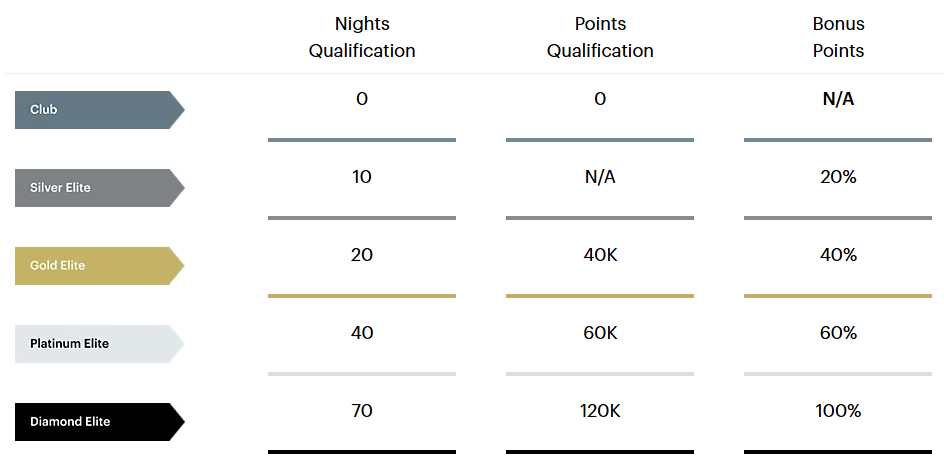
IHG One Rewards has five membership levels. The first three are earned through qualifying nights or qualifying points; the top two can also be accelerated through card spending.
Source: IHG One Rewards
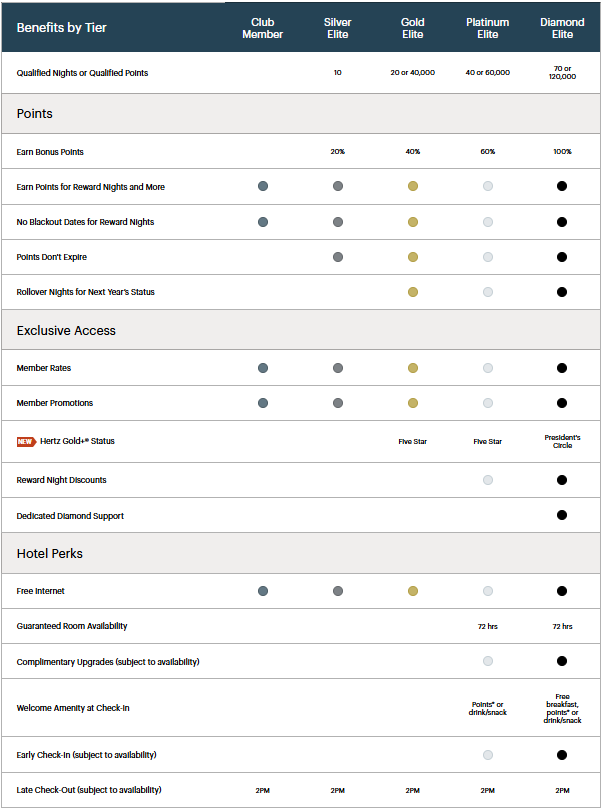
A few things worth noting: Platinum Elite is the most attainable meaningful tier for the average traveler — and the IHG One Rewards Premier card ($99/year) delivers it automatically, without needing to hit 40 qualifying nights or 60,000 qualifying points. That means complimentary upgrades, a welcome amenity at check-in, and early check-in access just for carrying the card.
One path to Platinum that doesn't get enough attention: the Chase Sapphire Reserve automatically confers IHG One Rewards Platinum Elite status — no IHG card required, no qualifying nights needed. CSR cardholders who reach $75,000 in annual card spending also unlock Diamond Elite status for the following calendar year, adding free daily breakfast and dedicated Diamond support to the existing Platinum perks. If you're already carrying the CSR, check your IHG account — you may have Platinum sitting unclaimed.
Here's the full picture of what each tier actually unlocks:
Source: IHG One Rewards
Diamond requires either 70 nights, 120,000 qualifying points, or $40,000 in annual card spending, which puts it out of reach for most people outside the CSR path. The daily free breakfast for two is the main upgrade at Diamond — substantial at full-service InterContinental and Crowne Plaza properties, but the bar to get there is high without the CSR shortcut.
Milestone Rewards are worth knowing about: starting at 20 qualifying nights per calendar year, IHG awards a choice reward every 10 nights up to 100 nights. Options include bonus points, additional elite benefits, or annual lounge memberships. If you're staying 20+ nights at IHG anyway, register for promotions and track your Milestone eligibility.
The Fourth Night Free - How It Actually Works
This is the benefit that makes IHG One Rewards worth understanding regardless of how many IHG nights you have. But the framing matters: the fourth-night-free is a credit card benefit, not a program perk available to all members. You need to hold one of three IHG co-branded cards to unlock it.
Here's what makes it unusual: one of those cards has a $0 annual fee.
The three cards with fourth-night-free access:
- IHG One Rewards Traveler — $0 annual fee, Silver Elite status, fourth night free on award bookings
- IHG One Rewards Premier — $99 annual fee, Platinum Elite status, fourth night free, annual free night certificate, and more
- IHG One Rewards Premier Business — $99 annual fee, identical benefits to the personal Premier
The mechanics are simple. When you book a consecutive award stay of four or more nights using points, you pay zero points for every fourth night. Book four nights, pay for three. Book eight nights, pay for six. The benefit repeats infinitely within a single stay, and there's no annual cap on how many times you use it. You don't need to call or request it — just log in, search for a four-night award, and the fourth night prices out at zero automatically.
"The only card in the industry with a $0 annual fee and a fourth-night-free benefit on points bookings. That sentence should get more attention than it does."
The math on this is worth running explicitly, because it's more powerful than it sounds at first.
Take a property at 50,000 points per night. Without the benefit: a four-night stay costs 200,000 points. With the fourth night free: 150,000 points. That's 50,000 points saved — worth roughly $250 to $400 at a property where cash rates justify the redemption. On longer stays, the savings compound. An eight-night stay that would cost 400,000 points costs 300,000 instead — 100,000 points back in your account.
If you're planning a single trip of four or more nights at an IHG property, the $0-annual-fee Traveler card is worth getting before you book. The fourth-night-free benefit on a single stay at a 40,000-point property saves you 40,000 points — worth $200 to $400 depending on the property. The card costs nothing to hold. The math almost always pencils out.
How to Earn and Top Up Your Points Balance
From IHG stays: Base IHG One Rewards members earn 10 points per dollar spent at IHG properties booked directly. Add the IHG Premier card (a 5x bonus for being a cardmember) plus Platinum Elite status (60% bonus on base earnings), and total earning at IHG properties reaches up to 26 points per dollar — among the highest earning rates for any hotel co-branded card on stays at that brand's properties.
From the IHG Premier card: The card also earns 5x points on dining, gas, and select categories outside of hotels. All other purchases earn 2x. It's not a card to use for everyday general spending versus something like the Citi Strata Premier, but the on-brand earning rate is genuinely strong.
From Chase Ultimate Rewards transfers: Chase Ultimate Rewards transfers to IHG One Rewards at a 1:1 ratio. Chase runs periodic transfer bonuses to IHG — typically two to three times per year, historically ranging from 50% to 100%, with a 70% bonus running as recently as April 2026. During a bonus window, 10,000 Chase points become 17,000 IHG points, which can make otherwise marginal redemptions pencil out convincingly.
The honest guidance: transferring Chase UR to IHG at the standard 1:1 ratio is generally not a good use of Chase points, since IHG points are worth significantly less than the alternatives (Hyatt at 1:1 is dramatically better value). Wait for a transfer bonus and have a specific redemption in mind before pulling the trigger. Never transfer speculatively.
From Bilt Rewards: Bilt also transfers to IHG at 1:1, offering another path to top up a balance if you have Bilt points and a specific IHG redemption lined up.
Points don't expire as long as you maintain Silver Elite or higher status — which just means holding the Traveler or Premier card, since both grant automatic elite status. Without status, IHG points expire after 12 months of account inactivity. Keep the Traveler card open and your balance is safe.
The Best IHG Redemptions Right Now
IHG's sweet spots concentrate in two places: Kimpton and InterContinental properties where cash rates are high but points costs are more reasonable, and anywhere that the fourth-night-free benefit applies to a stay that would otherwise cost significantly more in cash.
Here's a look at some of the program's standout redemptions and what 210,000 points — a reasonable balance to build — can get you at select properties:
Kimpton Seafire Resort + Spa, Grand Cayman: This is IHG's most-cited sweet spot, and it earns the reputation. Four consecutive nights at the Seafire — a beachfront luxury resort with cash rates running well above $700 per night in peak season — runs approximately 210,000 points using the fourth-night-free benefit (paying for three nights, getting the fourth free). That works out to roughly 1.5 cents per point: three times the program's average value, and meaningfully above the 0.91-cent breakeven we covered in our hotel points vs. cash back comparison.
Kimpton Gray Hotel, Chicago: A closer-to-home example that shows the fourth-night-free math working at a realistic domestic property. A four-night stay in October 2026 (October 14–18) prices at 97,500 points per night — and at a cash rate of $550 per night.
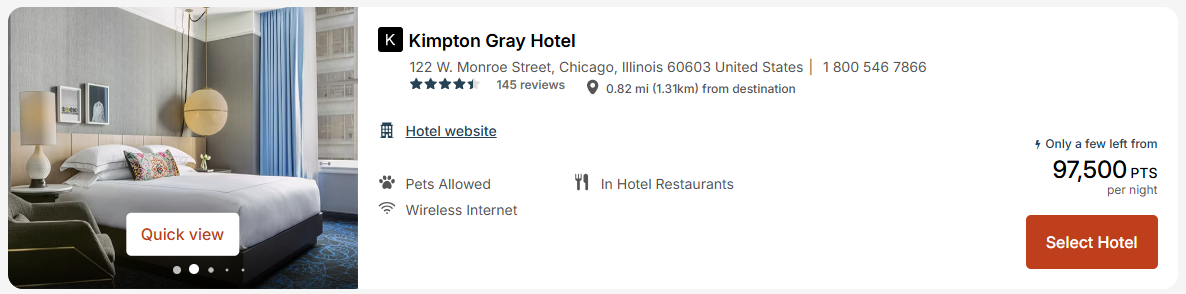
Kimpton Gray Hotel, Chicago — 97,500 pts/night, October 2026
Without the fourth-night-free benefit, four nights would cost 390,000 points. With it, you pay for three nights — 292,500 points — and the fourth night, worth $550 in cash, costs you zero. That's 97,500 points saved, or about $550 in avoided cash spend. The full four-night stay at $2,200 cash value costs 292,500 points, coming out to roughly 0.75 cents per point — comfortably above the program average, and with a downtown Chicago Kimpton as the backdrop. If you stack a Chase UR transfer bonus before topping up for this stay, the effective cost in Chase points drops further still.
InterContinental Danang Sun Peninsula, Vietnam: One of Southeast Asia's most celebrated resort hotels, with point costs around 81,000 per night for base rooms. If you're planning a Vietnam trip and building IHG points for this redemption, a four-night stay with the fourth-night-free benefit puts the total at 243,000 points for what would cost $1,200+ per night in cash. The math is compelling.
Hotel Indigo properties in expensive cities: Hotel Indigo is IHG's boutique lifestyle brand — design-forward, independently styled, often in neighborhoods where a Crowne Plaza wouldn't fit. Properties in Edinburgh, Lisbon, and London tend to have high cash rates relative to their points costs, making them disproportionately good value, especially on four-night stays.
Where IHG's luxury tier gets expensive: Six Senses properties can run 120,000+ points per night, and without the fourth-night-free benefit on a shorter stay, the math often favors cash. InterContinental flagship properties (London, New York, Hong Kong) also price at the high end. The program's sweet spots sit in the Kimpton and upper Hotel Indigo tier rather than the absolute top of the luxury portfolio.
How IHG Compares to Hyatt, Marriott, and Hilton
This is the honest positioning for where IHG fits in a smart travel wallet.
Averages are approximate and vary by property and redemption. Peak values reflect best attainable redemptions using each program's primary benefit. All figures in cents per point.
IHG vs. Hyatt: Hyatt wins on per-point value and on the quality of its luxury redemptions — Park Hyatt and Andaz properties represent the best cents-per-point in the hotel loyalty space. IHG wins on footprint (nearly 7,000 properties vs. Hyatt's roughly 1,200) and on the fourth-night-free benefit, which Hyatt doesn't offer at any fee tier. If you're a four-or-more-nights-per-stay traveler and Kimpton or InterContinental properties fit your destinations, IHG can compete with or beat Hyatt on specific redemptions.
IHG vs. Marriott: Both programs have comparable global footprints. Marriott's fifth-night-free benefit (Silver Elite or above, including through co-branded card) is similar to IHG's fourth-night-free — but IHG gets you there a night earlier, which is a meaningful difference on any stay of exactly four nights. Marriott's luxury tier (Ritz-Carlton, St. Regis, W Hotels) is deeper than IHG's. IHG's Kimpton portfolio competes with Marriott's Autograph Collection and Tribute Portfolio. Our full Marriott Bonvoy guide covers the program's mechanics in detail.
IHG vs. Hilton: Hilton's points are generally worth 0.4–0.6 cents each — roughly the same as IHG. Hilton has a marginally larger footprint, and Hilton's fifth-night-free benefit is available to Silver Elite members (which the no-annual-fee Hilton Honors Amex card provides). IHG's advantage is that the fourth-night-free is one night earlier, which is more useful for a typical four-to-five-night vacation. Hilton's luxury tier (Waldorf Astoria, Conrad) is stronger than IHG's for aspirational redemptions. See our Hilton Honors guide for the full picture on the 2026 tier overhaul and where Hilton points perform best.
The practical conclusion: IHG sits best in a wallet that already has a primary program — whether that's Hyatt, Marriott, or Hilton — and uses IHG as a complement for longer stays where the fourth-night-free benefit applies and for cities where IHG's footprint is the most convenient option.
Is the IHG Premier Card Worth the Annual Fee
The IHG One Rewards Premier card costs $99 per year. Here's the value case:
The annual free night certificate alone — redeemable at any IHG property that prices at 40,000 points or under — typically covers the annual fee and then some. A Kimpton in Chicago or a Crowne Plaza in a major city frequently prices in that range. Use it once per year, and the $99 fee becomes a formality.
The United TravelBank credit requires linking your MileagePlus account, which takes five minutes and earns you $50 in United travel credit — a benefit most Premier cardholders never take the time to claim. If you've ever bought a United ticket, it's worth doing.
For the cardholder who stays at IHG once a year for four or more nights and redeems one annual certificate: the card pays for itself with room to spare. For the cardholder who never stays at IHG properties: the value case is thinner, and the $0 Traveler card (which still gives you the fourth-night-free for those occasional stays) is the more honest choice.
If you're newer to travel credit cards generally, our best travel credit cards for beginners covers the foundational card stack before getting into co-branded options. And for a full framework on whether hotel points outperform straight cash back, see our hotel points vs. cash back analysis.
The Final Edit
IHG One Rewards isn't a program that demands loyalty from people who don't frequently stay in its properties. It's a program that rewards readers who understand one specific thing: a benefit that automatically reduces every fourth award night to zero — available on a card that charges zero dollars per year — is not a footnote. It's one of the best value mechanics in hotel loyalty, and most people walk past it.
The practical playbook is straightforward. Get the Traveler card before any IHG stay of four or more nights. Target Kimpton and InterContinental properties where cash rates are high enough for points to work hard. Collect Chase UR transfer bonuses when they appear and have a redemption lined up. Let the fourth-night-free do the math.
IHG won't replace your primary hotel program. It doesn't need to. It just needs to be the right tool when Kimpton Grand Cayman is on the itinerary and you're holding 210,000 points and a $0 annual fee card.
That's a good position to be in.
Card benefits, fees, and offers are subject to change — always verify current terms directly with the issuer before applying. The Global Edit may earn a commission if you apply for a card or book through links on this site. This does not influence our recommendations or editorial verdict.
Editorial Disclosure: This article was written with the assistance of artificial intelligence and reflects the author's honest research, experience, and editorial judgment. AI-assisted content on The Global Edit is always reviewed, edited, and approved by our editorial team before publication.